A 20-Year Bend: How One Hydraulic Platform Anchors Five Marine Programs
The U.S. pontoon market is dominated by a cluster of major Midwest brands that collectively define what aluminum tube bending has to look like at production volume. Five marine OEMs chose a different path: a single hydraulic railing bender platform, engineered once, running for over 20 years without a rebuild request. That platform — Bristol's hydraulic railing bender platform — generates approximately $510,000 per year in combined revenue and still holds the tolerances it held on day one.
Why Pontoon Rail Bends Fail When You Source Them Wrong
Pontoon railings are not decorative trim. They are the first structural element a passenger contacts, the first component a marina inspector notices, and the first part a quality auditor photographs when a warranty claim arrives. The geometry of a radius bend in marine-grade aluminum tube is deceptively demanding: the bend arc has to be consistent enough that rails from a Tuesday production run mate flush against stanchions machined two months earlier. The finish has to survive anodizing and powder coat without witness marks from tool slip. And the repeatability has to hold across thousands of cycles without the operator making compensating adjustments that silently accumulate as dimensional scatter.
When OEMs source aluminum tube bending from general-purpose equipment — rotary-draw machines dialed in by skilled operators, off-the-shelf hydraulic benders bought on specification sheets — they often get acceptable parts for the first few hundred cycles. Then the die wear begins. The spring-back compensation drifts. The operator compensates manually, which works until that operator is on second shift, or out sick, or replaced. What looked like a solved problem becomes a slow, grinding quality leak that never quite rises to the level of a formal corrective action but never goes away either.
The Midwest pontoon market is large enough that the major brands set reference standards for what a pontoon deck and railing package looks like. If your rails don't fit their visual and dimensional benchmark, your end customer notices — because they've seen the benchmark on the water every summer. That's the environment the marine OEMs were operating in when they came to Bristol Tool & Die. They needed railing bends in aluminum tube that were repeatable to the same geometry, day after day, shift after shift, year after year. They needed a machine that didn't require a specialist to run and didn't require a rebuild every time the program hit a volume spike.
They needed a platform, not a machine.
One Base Machine, Five OEM Variants
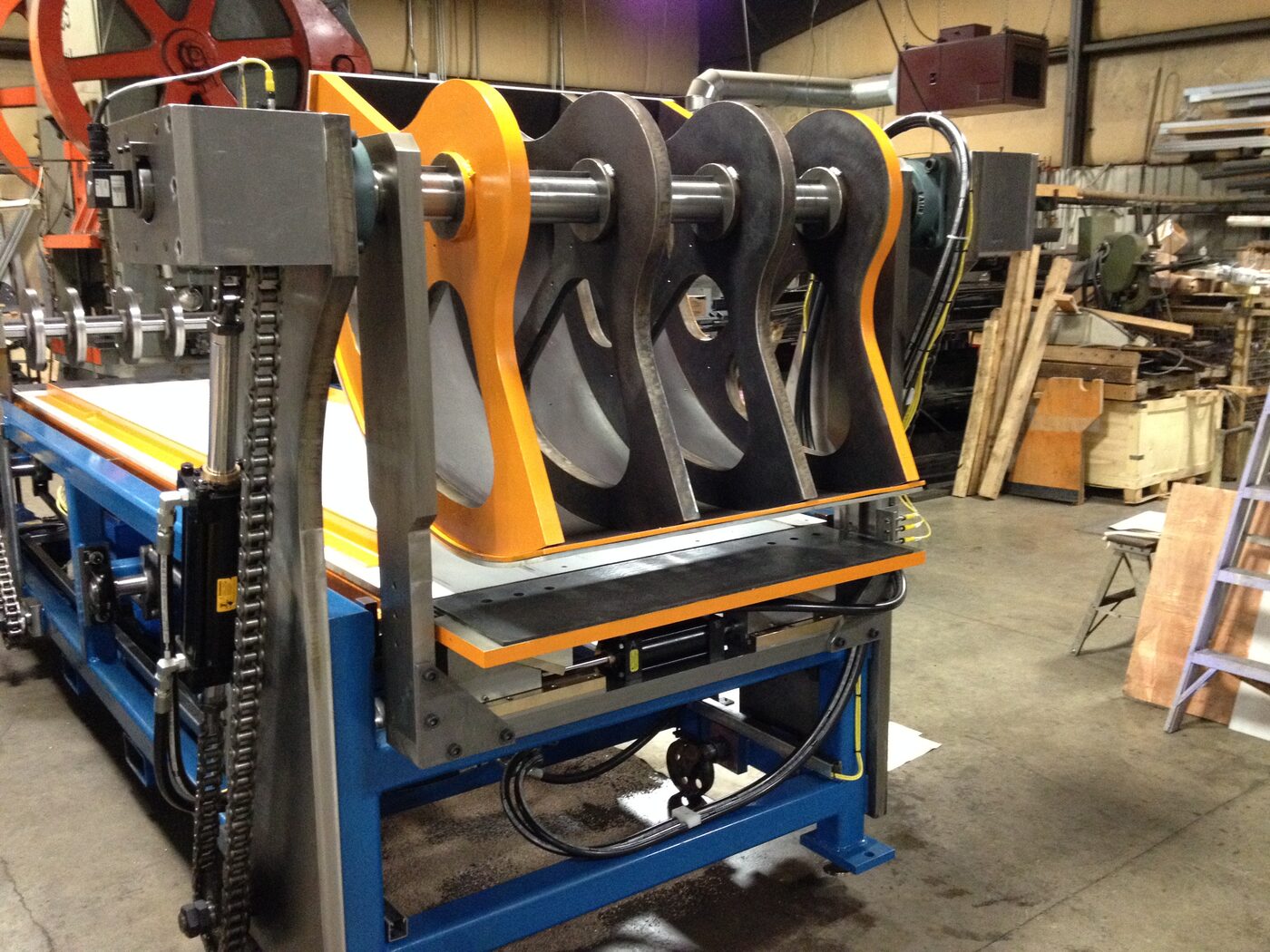
The hydraulic railing bender platform is a hydraulic railing bender — Bristol's designation for the platform they designed, built, and have supported across five separate marine customer programs running simultaneously. Each of the five OEMs has a variant tuned to their specific tube geometry, bend radius, and production rate. But the mechanical architecture is the same across all three: the same hydraulic power unit, the same control logic backbone, the same structural weldment that carries load without deflection across a decade of production use.
The platform approach matters because it changes the economics of engineering investment. When Bristol designed the first hydraulic railing bender platform variant, they made decisions about cylinder sizing, frame stiffness, tooling interface, and control feedback that would have to survive not just the first customer's volume but the demands of industrial production generally. Those decisions were not made once and forgotten. They were made with the understanding that a second and third customer would inherit the same architecture — and that any weakness in the base design would show up three times instead of once.
What that means in practice is that each OEM receives a machine with more engineering behind it than a single-customer build could justify. The tooling cassettes differ. The part programs differ. The safety guarding may differ to match each customer's cell layout. But the core hydraulic circuit, the cylinder geometry, the frame — those are proven. They carry 20+ years of production evidence that they work.
The platform holds consistent bend geometry part-to-part across all five OEM variants — each machine tuned to the OEM’s specific tube geometry, bend radius, and production rate, using common hydraulic architecture proven over 20+ years of production use.
The Hydraulic and Tooling Choices That Survived 20 Years of Three-Shift Use
Hydraulics are the right answer for radius bending at production volume in marine aluminum, and they are the right answer for specific reasons that matter when you're writing a purchase order that has to survive ten years. Servo-electric benders have their place — tight radius work, high-mix programs, applications where force feedback into the control system is the primary variable. But for a fixed-radius, high-volume aluminum tube program, hydraulics offer something servo-electric systems don't: force consistency under load variation without the sensitivity of a closed-loop servo to thermal drift, cable wear, or encoder contamination.
Aluminum tube is not homogeneous. Wall thickness varies within tolerance. Temper varies by lot. Lubrication condition at the bend zone varies by operator practice. A machine that holds its output geometry across those input variations is not just convenient — it's the difference between a process that a line operator can run reliably and one that requires a process technician standing by to make adjustments. Bristol's hydraulic circuit on the hydraulic railing bender platform was designed to absorb that variation and deliver consistent bend geometry regardless.
Tooling is where aluminum bending programs most often fall apart over time. Aluminum is soft enough to permit die materials that look adequate at first but wear faster than the program requires. The hydraulic railing bender platform tooling was specified for the full production life of the program — materials and surface treatments chosen not for first-article acceptance but for the ten-thousandth part looking the same as the first. Finish risk on aluminum tube bending is real: die marks, galling, and surface drag in the bend zone show up under anodizing in ways that are not visible on raw aluminum. Bristol's tooling interface was engineered to minimize contact pressure at the tube surface while maintaining the geometric constraint that produces a repeatable bend arc.
The result is a platform that has run for over 20 years across five OEM programs with near-zero rebuild requests. That is not an accident of easy production conditions. Pontoon railing programs run at the pace of the marine build season — compressed schedules, high volume, repeated setups. The hydraulic railing bender platform was designed to be reset between variants quickly, to hold its calibration across those setups, and to require no specialized maintenance beyond what a capable maintenance technician can perform with standard tooling and the documentation Bristol provides.
The platform’s durability record reflects design decisions made at the outset: cylinder sizing, frame stiffness, tooling material selection, and control architecture built to outlast the program rather than be rebuilt at regular intervals.
The Economics: $510K Per Year, Five Marine OEMs, Near-Zero Rebuild Requests
The numbers on the hydraulic railing bender platform program are worth examining not just as revenue figures but as evidence of what a durable platform relationship looks like in custom automation.
Five marine OEMs. Approximately $510,000 per year in combined revenue. Twenty-plus years in continuous production. Near-zero rebuild requests in that span. Those four facts together describe something that is genuinely unusual in custom machine building: a platform that generated a reasonable return for Bristol in the first year and then continued generating that return for a decade without requiring Bristol to re-earn it through remediation work.
Custom automation economics are often discussed from the OEM's side — what the machine costs, what the payback period is, what happens if it goes down. The builder's economics matter too, because they drive behavior. A machine that requires constant builder support is a machine where the builder is motivated to bill for support visits, not to design the support visits out. A machine with near-zero rebuild requests is a machine where the builder had a strong incentive at the design stage to make it last — and delivered on that incentive.
For each of the five OEM customers, the hydraulic railing bender platform represents a capital investment that has paid for itself many times over. The machine cost is amortized. The operator is trained. The cell is integrated into the production line. The quality of the output is known and predictable. The cost of replacing that machine — not just the purchase price, but the validation time, the operator retraining, the first-article qualification cycle, the risk of a production gap during changeover — is high enough that the existing platform is the right economic choice every year it continues to perform.
That's the compounding return on a correctly engineered custom machine. It doesn't depreciate the way commodity equipment does, because its value is not just in the metal and hydraulics — it's in the institutional knowledge of how it was set up, validated, and integrated into a specific OEM's production environment. Bristol carries that knowledge. The OEM benefits from it every shift the machine runs.
What This Means for Any OEM Running Aluminum Tube Programs at Volume
The hydraulic railing bender platform story is not specific to pontoon railings. The structural lessons apply to any aluminum tube bending program that has moved past prototype and into sustained production volume: RV grab rails, marine ladder stanchions, architectural tube bends, recreational vehicle frame components, trailer safety chains, industrial conveyor returns. Wherever a fixed-radius bend in aluminum tube has to hold geometry across thousands of production cycles, the design decisions Bristol made on the hydraulic railing bender platform are relevant.
The first lesson is that platform thinking beats single-machine thinking when you have more than one program with similar geometry requirements. If your engineering group is managing three tube bending programs on three separate machines from three separate vendors, you are carrying three sets of spare parts, three sets of operator procedures, three service relationships, and three failure modes. A platform built around a common hydraulic architecture, with tooling cassettes that differentiate the programs, is a simpler system — and simpler systems are more reliable.
The second lesson is that tooling specification at purchase time is not an afterthought. The difference between tooling that lasts three years and tooling that lasts ten is not a large cost difference at purchase — it is a materials and surface treatment decision that costs a fraction of the machine price but determines whether you have a rebuild conversation at year three or year ten. Bristol's engineering bench — three engineers carrying over 100 combined years of experience in custom automation — makes those tooling decisions at design time, not after the first warranty claim.
The third lesson is that hydraulic force consistency matters more than hydraulic precision in high-volume aluminum bending. The question is not whether the cylinder extends to the exact same position on every cycle — it is whether the bend geometry at the tube stays consistent as input variables (lot-to-lot material variation, lubrication, ambient temperature) fluctuate across a production shift. A hydraulic circuit designed to absorb those variables is the engineering answer. It is not the fashionable answer in an era of servo-electric evangelism, but it is the correct answer for this class of program.
The fourth lesson is that ten years without a rebuild request is a design achievement, not a maintenance achievement. You cannot maintain your way to a 20-year maintenance-free record on a machine designed to require quarterly rebuilds. The hydraulic railing bender platform's record reflects decisions made before the first part was ever bent: frame stiffness, cylinder sizing, tooling material selection, control architecture. Get them right at the beginning and those decisions compound in your favor. Get them wrong and you pay the difference in maintenance hours and production interruptions for as long as the machine runs.
When to Call Bristol Instead of Buying Off the Shelf
Off-the-shelf tube benders exist for a reason. If you are bending one radius in one tube size at low volume with no finish requirements and no part-to-part repeatability tolerance, a standard machine dialed in by a skilled operator is probably the right answer. The capital cost is lower, the lead time is shorter, and the application doesn't justify custom engineering.
The call changes when any of the following are true: your program runs at volume high enough that operator skill variation is a quality risk; your tube has a finish requirement that survives anodizing or powder coat; your bend geometry has to match mating components dimensioned to a tighter tolerance than general-purpose equipment delivers; your program runs long enough that tooling longevity is a real cost factor; or you have more than one program with similar geometry that could share a platform architecture.
Bristol's custom automation range runs from $150,000 to $750,000 and above, with typical lead times of six to ten months. The hydraulic railing bender platform sits in that range — a purpose-built solution that has returned its cost to five OEMs many times over across 20+ years of production.
Bristol Tool & Die – Automation is a veteran-owned manufacturer based in Bristol, Indiana. The engineering team carries over 100 combined years of experience across custom automated machines, progressive stamping dies, CNC machining, wire EDM, high-speed waterjet cutting, and controls integration. The 23-station shackle-link assembly cell for a Tier-1 RV chassis OEM has logged over four million part cycles. The arm-bar press platform for a leading trailer-axle manufacturer was described by their engineering leadership as the heart and soul of their suspension line. The hydraulic railing bender platform has run for 20+ years across five marine OEMs without a rebuild request.
If your aluminum tube program is running at volume and you are managing it on equipment that wasn't designed for your geometry, your finish requirements, or your production cadence — that gap is worth a conversation. Reach Bristol's engineering team at RFQ form or 574-848-5354.
Frequently Asked Questions
Common questions about this case.
What is the hydraulic railing bender platform?
The hydraulic railing bender platform is a hydraulic railing bender platform designed and built by Bristol Tool & Die – Automation. It has been running continuously for over 20 years across five separate marine OEM programs, producing aluminum tube bends for pontoon railings at production volume. The platform uses a common hydraulic architecture with OEM-specific tooling variants, meaning each customer gets a machine tuned to their geometry while benefiting from the engineering depth of a multi-customer platform.
Why choose a hydraulic railing bender over a servo-electric bender for aluminum tube production?
For fixed-radius, high-volume aluminum tube programs, hydraulics deliver force consistency under input variation — lot-to-lot material differences, lubrication variation, and ambient temperature changes — without the sensitivity of servo-electric systems to thermal drift, cable wear, or encoder contamination. The hydraulic railing bender platform's hydraulic circuit was designed to absorb those variables and deliver consistent bend geometry across a full production shift without requiring operator compensation adjustments.
How long has the hydraulic railing bender platform been in continuous production, and how many OEMs use it?
The hydraulic railing bender platform has been in continuous production for over 20 years across five marine OEM programs. Combined, those programs generate approximately $510,000 per year in revenue. In that span, the platform has generated near-zero rebuild requests — a record that reflects design decisions made at the engineering stage, not maintenance heroics in the field.
What types of aluminum tube bending programs are a good fit for a custom platform approach?
Programs that benefit most from a custom hydraulic platform include: high-volume runs where operator skill variation is a quality risk; applications with finish requirements that survive anodizing or powder coat; programs requiring part-to-part repeatability tighter than general-purpose equipment delivers; and OEMs managing multiple programs with similar geometry that could share a common machine architecture. Bristol's custom automation range runs from $150K to $750K+, with typical lead times of 6–10 months.
Ready to discuss your project?
Tell us your part, your volume, and your timeline. We’ll respond within one business day with a clear next step.