Multi-Station Custom Production Automation, Designed and Built in Bristol, Indiana
Multi-station production systems — 4 to 30 stations, Allen-Bradley CompactLogix/ControlLogix, servo-driven indexing, Cognex In-Sight vision — engineered for repeatable quality and 20+ year service life. A 23-station shackle-link assembly machine we built for a leading North American RV chassis supplier has run 4M+ cycles and is still in production. Typical scope: $150,000 to $750,000. Six- to ten-month lead.
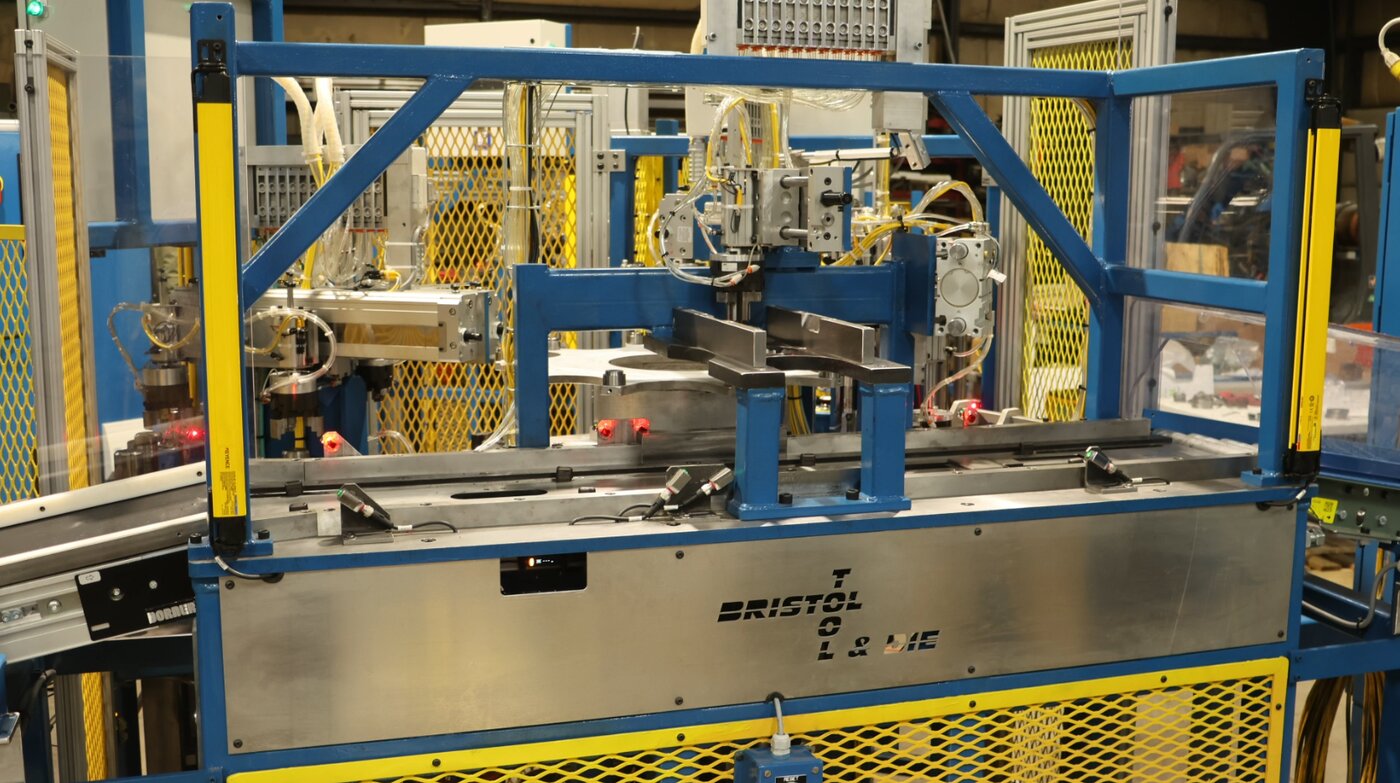
Bristol-built automation, defined by what it does in production
When the cell that runs your highest-volume part has to deliver repeatable quality the day it's installed — and keep delivering it ten years later — the integrator you pick stops being a procurement decision and becomes a business-continuity decision. That's the work Bristol is built to do. Our machines don't get handed off to a subcontractor for controls or sourced out for build. The engineer who writes your concept owns the build through runoff.
The 23-station shackle-link assembly machine we built for a leading North American RV chassis supplier has accumulated 4 million+ part cycles and is still in production. The arm-bar press a leading suspension OEM calls the heart and soul of their suspension line is ours. The grease machine that took a 45-second manual operation to 8.5 seconds is still running. Those outcomes don't happen by accident — they happen because we build to industrial duty cycles, oversize the structural elements, and design in a second decade of serviceability before the first part runs.
Six checkpoint gates. No engineering subcontractors.
Every Bristol build runs on six customer-signed checkpoint gates between PO and runoff. The customer signs off at concept, at engineering design review before any metal is cut, at factory acceptance test, and at the customer-witnessed site acceptance test and runoff. There is no engineering subcontractor, no controls subcontractor, no third party between you and the people writing your PLC code. When scope changes or schedule implications arise, we communicate them as they become understood — not after the fact.
The equipment behind every cell we ship
- Charmilles Robofil Wire EDM (x2) — precision die details, cam profiles, hardened tooling components to ±.0001″.
- Hurco 3-axis CNC machining center — station bases, plates, custom brackets.
- CNC lathes — shafts, bushings, hardware turned to print.
- OMAX abrasive waterjet — structural plates, frame components, cover panels.
- Kent surface grinder & Lucas horizontal boring mill — die surface finish and large-bore precision work.
Control platforms, vision, sensors, and motion — engineered by the team that built the machine
Because the controls engineer is in the same building as the mechanical engineer throughout the entire build, platform decisions happen at design time — not at integration, when the schedule has no slack. Sensor placement is decided when the bracket is designed. Safety category is selected when the guarding is drawn. Technologies deployed across our custom machine builds:
- Advanced automation — PLC controls, AC and DC drives, servo controls
- Hydraulics & pneumatics — proportional systems, valve manifolds, cylinders
- HMI with part selection — recipe-based part programs, operator guidance screens, fault recovery
- Process equipment — to apply glues, chemicals, solder, tape, and labels
- Mechanical machines — drill, tap, bend, saw, punch, inspect, lance, coin, laser etch, weld, cut-off, count
- Assembly machines — press, stake, insert, fasten, and assemble sub-components
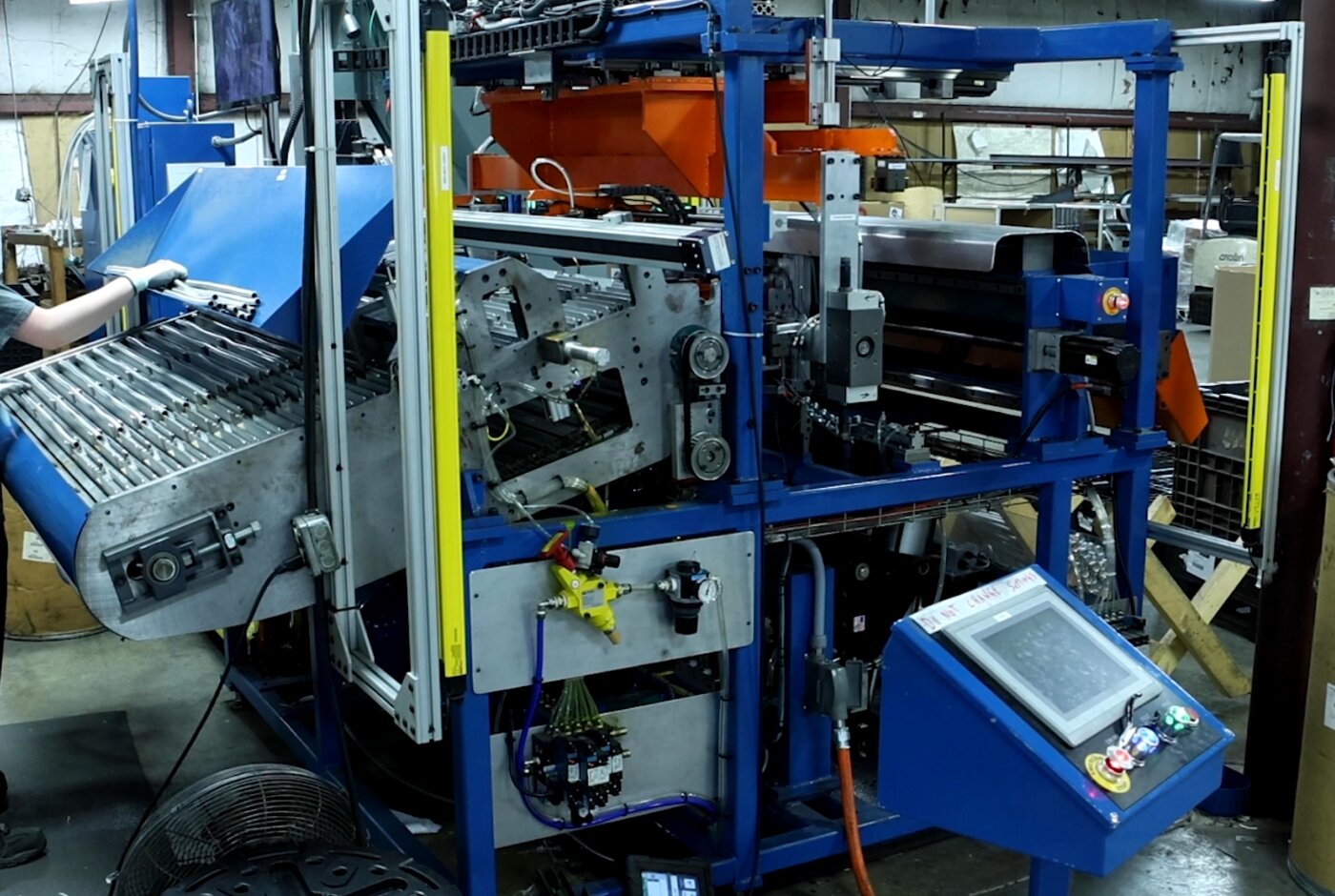
Pick, Place, Test & Press: what a complex Bristol build looks like
Three independent safety zones, AI vision systems, HMIs, servos, pneumatics, safety PLCs, linear slides, index table, and grippers — all engineered as one system by the same team. Each zone independently safety-rated; AI vision handles part presence, orientation, and dimensional verification before press operations execute. Designed, built, and commissioned at one address.
Jigs & Fixtures — built by the same machinists who built the machine
Twenty-five years of fixture work means our designers have already solved the problem you're describing. Assembly holding fixtures, drill jigs, weld jigs with trunnion mounts, and dimensional check fixtures — designed to the same tolerance standards and produced on the same equipment as the production tooling they support.
- Assembly holding fixtures — keep parts located and clamped during assembly or joining operations.
- Drill jigs — guide saws, drills, and other machining tools to hit the part in the right spot every time.
- Weld jigs — part locating, clamping, and trunnion mount plates for production welding cells.
- Dimensional check fixtures — verify that holes are in the right locations and sizes, and that profiles are within tolerance.
Repair & Refurbish — because a Bristol-built machine is worth saving
The machines we built in the 2000s are still in field service because we build to survive. When one needs attention — worn tooling, an obsolete controls platform, a structural modification — we handle it. No sending the job to a third party who has never seen the original design drawings.
- Process equipment, mechanical machines, assembly machines, and test equipment
- Replace worn components; repair broken details to like-new
- Test and reuse existing components as appropriate; add safety features where required
- Covers all machine types we build: grease machines, drill & tap machines, assembly presses, test cells
The proof: machines in continuous production 10, 15, and 20+ years later
A Tier-1 RV chassis and components OEM — 23-station shackle-link assembly machine. Before installation: 5 operators, 5-day week. After: 3 operators, 3-day week. The machine has since accumulated 4 million+ part cycles in continuous production and is still running. References available during qualification under NDA.
The same OEM — grease machine. Manual process: 45 seconds per part. Bristol-built machine: 8.5 seconds per part — a 1.74× reduction in labor input at the higher cycle rate. Still running.
hydraulic railing bender platform. Pontoon railings for five active marine OEMs. Ten-plus years in continuous production. Approximately $510,000 in annual revenue across the platform. Same machine. Same buyers.
A machine without a supportable builder behind it is an asset on its way to becoming a problem. Bristol's 25-year continuity at one address — through two recessions and a pandemic — is part of what you're buying.
Six steps from concept to production support
Concept & scope
Part print, volume, quality envelope, environment. Station-by-station concept with cycle math and budget.
Engineering & design
Full CAD with motion simulation, controls architecture, safety category. Customer design review before metal is cut.
Build & assembly
Fabrication on boring mill, waterjet, and weldment cells. Precision details on CNC and wire EDM. Stations tested before integration.
Controls integration
Schematic design, panel design & wiring, PLC programming, machine wiring, sensor calibration, safety circuit verification, HMI logic tested against design intent.
Runoff & acceptance
Customer-witnessed factory acceptance test at our facility. Site acceptance test at your facility. Documented repeatability data, first-article parts signed off, and full feature sign-off.
Install & support
Field install and startup. Operator training. Documented service relationship for the life of the machine.
A machine without a supportable builder behind it is an asset on its way to becoming a problem. Our 25-year continuity is part of the product.
Charles Reitsma, CEOFrequently Asked Questions — Custom Automated Machines
What buyers, engineers, and procurement teams want to know before quoting a Custom Automated Machines project.
How much does a custom automated machine from Bristol typically cost?
Typical custom automation builds at Bristol Tool & Die – Automation range from $150,000 to $750,000, with select programs above that range. The cost is driven by:
- Station count and process complexity
- Cycle-time target and throughput
- Material handling and part presentation
- Inspection, traceability, and data collection scope
- Controls platform and safety category
For an early-stage budgetary number we typically need a conversation and a part print.
How long does a custom machine build take from PO to runoff?
Typical lead time from purchase order to customer-witnessed runoff is six to ten months, depending on scope. Smaller single-station or two-station systems can run shorter; large multi-station transfer systems and integrated cells with vision and traceability run longer.
The schedule is built around customer design review checkpoints, not assumed. We do not begin manufacture until the design package is approved.
What information do you need to quote a custom automation project?
To produce a meaningful quote we need:
- Part print or 3D model
- Annual production volume and order pattern
- Takt time or cycle target (buyer-provided as a target; not a contractual Bristol deliverable)
- What parts of the process you want to automate
- Type of loading: automatic loading (more capable, higher cost), manual loading (lower cost, higher labor), or manually loaded feeders (moderate cost; operators can multitask)
- Pictures or a short video of your existing process
- Any known must-have equipment and part numbers from your current process
- Quality requirements: tolerances, inspection points, traceability
- Operating environment: floor space, utilities, upstream/downstream integration
- Any required controls platform (Allen-Bradley, Siemens, Automation Direct) or safety standard (ISO 13849, ANSI B11, NFPA 79)
A site visit or a short video of the current manual process is often the fastest way to scope a build accurately.
Do you provide service and spare parts after the machine ships?
Yes. Every custom machine ships with:
- Documented spare-parts list with vendor part numbers
- Complete electrical drawings (schematic plus terminal layout)
- Mechanical drawings of every custom-fabricated component
- PLC program source code where the customer requires it
- Operator manual and maintenance manual
Complete electrical and mechanical drawings, a documented spare-parts list, PLC source code where required, and operator & maintenance manuals ship with every machine. We provide field service, remote troubleshooting, and parts support for the life of the machine. Machines built in the 2000s and 2010s are still under our active service relationship today.
Can Bristol retrofit or rebuild an existing machine instead of starting from scratch?
Yes. Retrofit work is a regular part of our business:
- Replacing obsolete controls on a 1990s or 2000s machine with current PLC and HMI
- Replacing worn or obsolete die stations on an automation cell with updated tooling
- Adding inspection, vision, and traceability to a legacy system
- Repowering and upgrading material handling on aging transfer lines
Retrofits are typically faster and cheaper than new builds when the structural platform is sound. We will tell you honestly when the structural platform is not sound and a new build is the better economic choice.
Does Bristol design the machine in-house or outsource engineering?
All mechanical, controls, and integration engineering for Bristol-built machines is performed in-house at our Bristol, Indiana facility. The same team that designs the system runs the build and witnesses the runoff. There is no engineering subcontractor between the buyer and the engineers.
For specialty subsystems — vision, robotics, certain inspection technologies — we partner with established platform vendors and integrate their products into our build.
Industries using Custom Automated Machines
The same capability serves different industries differently. These pages show how this discipline is applied for specific buyer types and project profiles.
Ready to discuss your project?
Tell us your part, your volume, and your timeline. We’ll respond within one business day with a clear next step.