The Hidden Cost of Vendor Complexity in Industrial Manufacturing
Most industrial OEMs don't lose programs to bad vendors — they lose them to the space between vendors. When a die shop, a machine builder, a controls integrator, a waterjet house, and a fixture supplier each own a slice of the same program, nobody owns the whole thing. Bristol's six in-house capabilities collapse that stack into a single accountable relationship.
Count Your Vendors Before You Count Your Risk
Walk a typical mid-scale industrial program back to its supplier map and you'll find the same pattern: a die shop for stampings, a custom machine builder for the assembly cell, a controls integrator for the PLC and HMI, a waterjet or profile shop for structural plate and brackets, a fixture supplier for weld and check fixtures, and a repair vendor waiting in the wings for year two. Six vendors. Six project managers, drawing conventions, lead-time calendars, and quality systems.
Each one is a specialist. Each one, evaluated on its own terms, is probably competent. The problem is not the vendors — it's the architecture. Every handoff between suppliers is a coordination tax your team pays without a line item on any invoice. It shows up as schedule slip, as rework at integration, as finger-pointing during runoff, and eventually as a program that delivers six months late and $80,000 over budget with nobody technically at fault.
This is the hidden cost of vendor complexity. It doesn't appear in any quote, and it never shows up on a Gantt chart until it's already happened. For VP-level manufacturing and sourcing leaders, it is one of the highest-leverage risks in a capital program — because the mitigation is a sourcing decision made at RFQ, not a corrective action issued at runoff.
The Math of the Coordination Tax
Schedule slip probability compounds
Assume each of your five vendors has a 25% chance of slipping two weeks on their deliverable. That's an optimistic estimate for custom industrial work. The probability that at least one of the five slips is 1 − (0.75)5 ≈ 76%. The probability that the slip falls on the critical path — because at least one vendor feeds the next — is near-certain on any integrated program. You are not managing five independent 25%-slip risks. You are managing one near-certain slip, with uncertainty only about which vendor triggers it and how far it cascades.
For custom automation programs in the $150K–$750K range, a two-week slip on a sub-vendor's delivery typically produces a four-to-eight-week slip at system-level runoff. The integration schedule has no slack for late components. Assembly, tryout, and controls debug are sequential. Everything piles up at the end.
PMO overhead is real and undercounted
Managing five active vendor relationships across a 30-week program requires coordination most manufacturing PMO teams absorb as overhead rather than charging to the program: status calls, drawing revision distribution, RFI management, inspection coordination, integration sequencing. A conservative estimate for a medium-complexity cell is 8–12 hours per week of senior project manager time. At 30 weeks, that's 240–360 hours. At any fully-loaded internal labor rate, that is a real program cost that never appears on a PO comparison.
QA gap risk at integration
Each vendor certifies their own work to their own scope. Nobody certifies the seams. A progressive die that produces parts measuring to print can still produce parts that don't reliably assemble in a machine built to a different engineer's tolerance interpretation. The machine builder's fixture, also built to spec, is also correct. The first-time-through yield at runoff is the measure of how well those interpretations aligned — and it's the one number nobody quoted you.
The Finger-Pointing Failure Mode, in Real Terms
The finger-pointing failure mode activates at integration — usually at first-article runoff or installation — when the system doesn't perform to specification and every vendor's individual work product can be shown to be nominally correct.
The die shop's parts measure to print. The machine builder's fixtures are to spec. The controls integrator's PLC logic executes correctly. The waterjet shop's plate is flat and square. And the cell doesn't make good parts at rate. Every vendor has a paper defense. Nobody has accountability for the system.
The resolution path is expensive: a war-room meeting with representatives from each vendor, a root-cause process that becomes a negotiation over who pays for the fix, and a change-order cycle that favors whoever has the most leverage — which is never the buyer. A program quoted cleanly across five vendors ends with $40,000–$120,000 in unplanned change orders and a production launch slipped into the next model year.
Buyers who have lived through this once — and most VP Manufacturing and sourcing directors have — learn to price seam risk into their vendor evaluation. The ones who haven't are learning it now.
What an Integrated Supplier Actually Means
Integration is a specific claim. It means one engineering team designed the die with full knowledge of the assembly machine it feeds. It means the controls engineer was in the room when the mechanical engineer laid out the motion sequence — not handed a finished mechanical design and asked to write a PLC program around it. It means fixture geometry was checked against die geometry by engineers who share a revision-control system, not emailed across vendor boundaries.
At Bristol, the six in-house capabilities are not six departments handing work across internal POs. They are one shop, one engineering team, and one set of decisions made by people who will all be at the runoff.
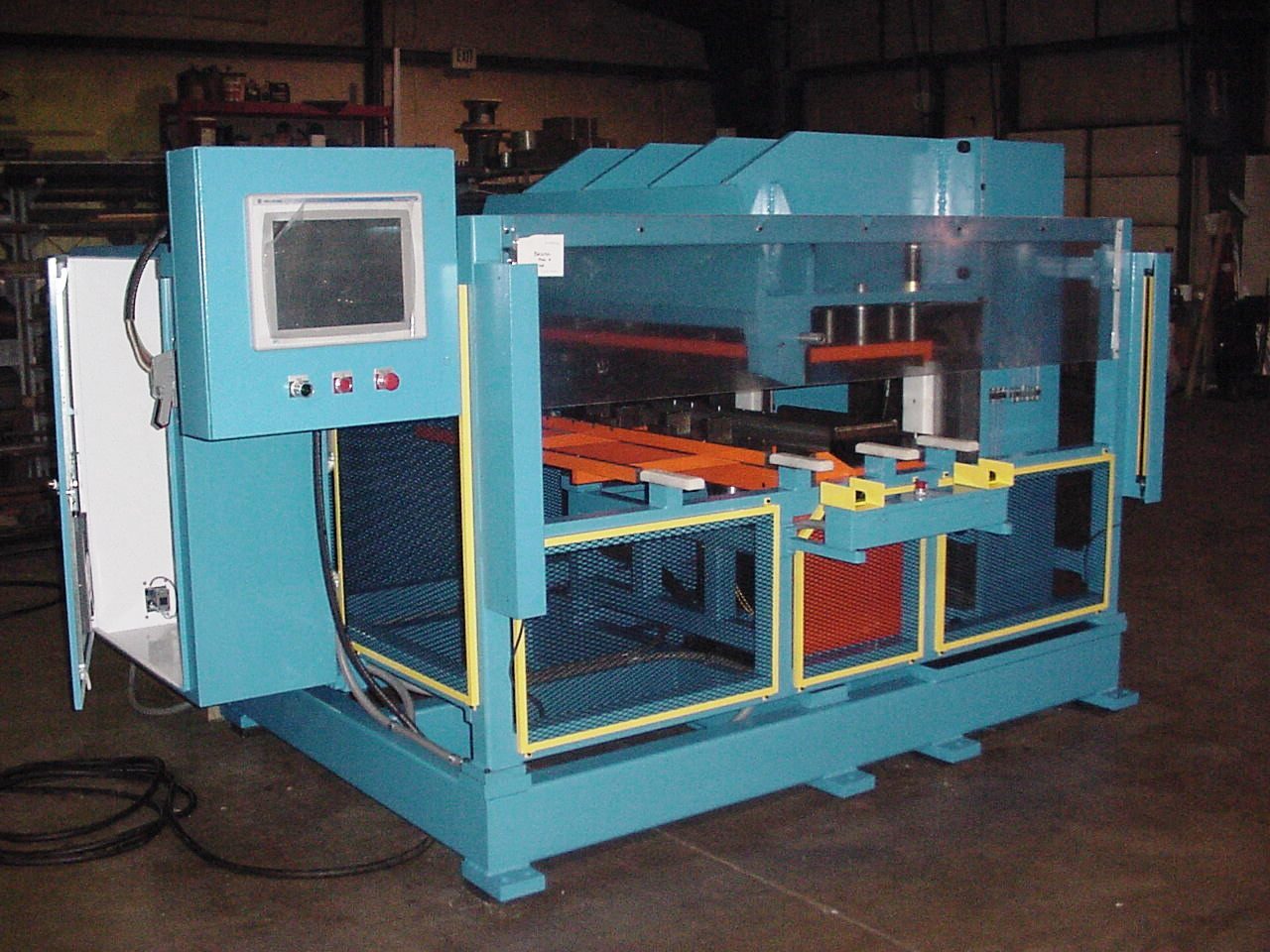
- Custom Automated Machines — PLC controls, AC/DC drives, servo systems, hydraulics and pneumatics, HMI with part-selection interfaces. Assembly, staking, forming, labeling, laser etching, welding, and multi-station progressive assembly.
- Progressive Stamping Dies — One-hit, progressive, transfer, and two-out dies. Full operation set: cutoff, coining, drawing, forming, lancing, notching, piercing, punching, trimming. Tryout on the Bliss 200-Ton straight-side press in-house, so die performance is confirmed before the die ships.
- CNC Machining + Wire EDM — Hurco 3-axis mills, CNC lathes, 2× Charmilles Robofil Wire EDM holding ±0.0001″. Precision components are made in-house to the tolerances the system was designed around.
- High-Speed Waterjet — OMAX abrasive waterjet on a 10′×20′ cutting table, up to 6″ steel at ±0.005″. Structural plate and profiled components are cut in-house, not routed to a third-party profile shop with its own revision calendar.
- Controls Integration — Controls architecture is co-designed with the mechanical and tooling team from kickoff, not bolted on at the end of the mechanical build. The result is a controls package native to the machine, not adapted to it.
- Extrusion Tooling & Fabrication — Hydraulic notch-and-pierce machines, cut-off and notching systems for solids, tubing, semi-hollows, and channels, and rotary indexing drill-and-tap machines. Programs involving extruded components stay in-house.
The proof is in the production numbers. A 23-station shackle-link assembly cell built for a Tier-1 North American RV chassis and components OEM has accumulated more than 4,000,000 part cycles in continuous production. A 14-station progressive die with dual-direction forming has been running for 10+ years. An arm-bar press platform built for a leading trailer-axle and suspension manufacturer is described by that company's engineering leadership as the heart and soul of their suspension line. These systems survived because all the subsystems were designed together, by the same team, with shared accountability for the result — not because any one subsystem was over-engineered in isolation.
Bristol's engineering bench — 3 engineers and 2 senior designers representing 170+ combined years of tooling and automation experience — operates out of a single Indiana facility serving national OEM customers. The 25+ years of fixture and jig work that underpins that record means the check fixture and the die it validates were designed by the same engineers. There are no drawing-interpretation gaps to discover at runoff.
When Not to Consolidate
Intellectual honesty requires this section. There are programs where multi-vendor sourcing is the correct answer.
Consolidation adds value when integration risk is high: when subsystems feed each other, when tolerances stack across disciplines, when schedule dependence between deliverables is tight. These conditions apply to most complex custom automation and tooling programs in the $150K–$750K+ range.
Consolidation adds less value — and may add cost — when the program is genuinely simple and the subsystems are independent. A one-off waterjet-cut bracket requiring no downstream fitting. A single-cavity die with no associated automation. A controls retrofit where the mechanical system is defined and the electrical scope is fully contained. In these cases, forcing consolidation to a generalist adds overhead without removing integration risk, because there is no integration risk to remove.
The right question is not "should I always use one vendor?" It is: "Where are the seams in this specific program, and who is accountable for them?" If the honest answer is "nobody, because each vendor only owns their scope," that is the argument for consolidation. If the honest answer is "there are no meaningful seams because the scopes are genuinely independent," consolidation is optional.
The Close: What to Ask on the Next RFQ
Before issuing your next multi-vendor RFQ for a complex tooling or automation program, ask one question: who on this vendor list will be accountable when the subsystems don't fit together at runoff?
If the answer is "my internal project manager," you have accepted the coordination cost as fixed overhead. That is a choice — but it is not a free choice. It carries a real cost that should appear in your program budget, your schedule contingency, and your change-order reserve.
If the answer is "one of the vendors," ask them to define their scope of accountability in writing — specifically including integration performance, not just individual deliverable performance. Watch how quickly that conversation reveals whether you actually have a single accountable party.
Bristol's six in-house capabilities were built to answer that question cleanly. One PO, one engineering team with 170+ combined years of experience, one Bliss 200-Ton in-house tryout press, and one set of engineers accountable for the system — not just for their slice of it. For national OEM customers with complex programs and real schedule pressure, that accountability structure is the product.
Reach out at RFQ form or 574-848-5354 to discuss whether your next program is a consolidation candidate.
Frequently Asked Questions
Common questions about this topic.
How do I quantify the coordination cost of a multi-vendor program before it happens?
Estimate PMO hours explicitly: count active vendor relationships, multiply by weekly coordination hours per relationship, and multiply by your fully-loaded internal labor rate.
For a five-vendor program over 30 weeks, 8–12 hours/week is conservative — that's $30,000–$50,000 in internal labor before any rework or schedule-slip cost. Run this number on your last three programs and compare it to the price difference between the lowest multi-vendor quote and an integrated supplier's quote.
What does Bristol's single-source model actually cover, and where does scope end?
Bristol's six in-house capabilities: Custom Automated Machines, Progressive Stamping Dies, CNC + Wire EDM, High-Speed Waterjet, Controls Integration, and Extrusion Tooling & Fabrication.
For capabilities outside this set, Bristol uses qualified sub-vendors while maintaining program management accountability for the full system. Scope boundaries are disclosed at RFQ — not discovered at runoff.
How does in-house die tryout affect integration quality?
Bristol runs die tryout on a Bliss 200-Ton straight-side press on-site in Bristol, Indiana. Die performance is confirmed before the die ships.
For integrated programs, the parts produced in tryout are the same parts the assembly cell validates against — closing the tolerance-stack loop before the system reaches your floor. Multi-vendor programs reconcile that tolerance gap at the machine builder's dock, on your schedule.
Is vendor consolidation realistic for sourcing directors at large OEMs with approved vendor lists?
Yes, with the right framing. The argument is not 'use fewer vendors on principle' — it's 'consolidate integration risk into one accountable party on complex programs.'
Build the business case on total program cost: at-purchase price + PMO overhead + change-order reserve + schedule contingency. When those four numbers are compared honestly, the consolidation argument typically closes itself. Bristol can support that business case analysis for qualified programs — contact 574-848-5354.
Ready to discuss your project?
Tell us your part, your volume, and your timeline. We’ll respond within one business day with a clear next step.