
23-Station Shackle-Link Assembly Cell — 4,000,000+ Cycles and Counting
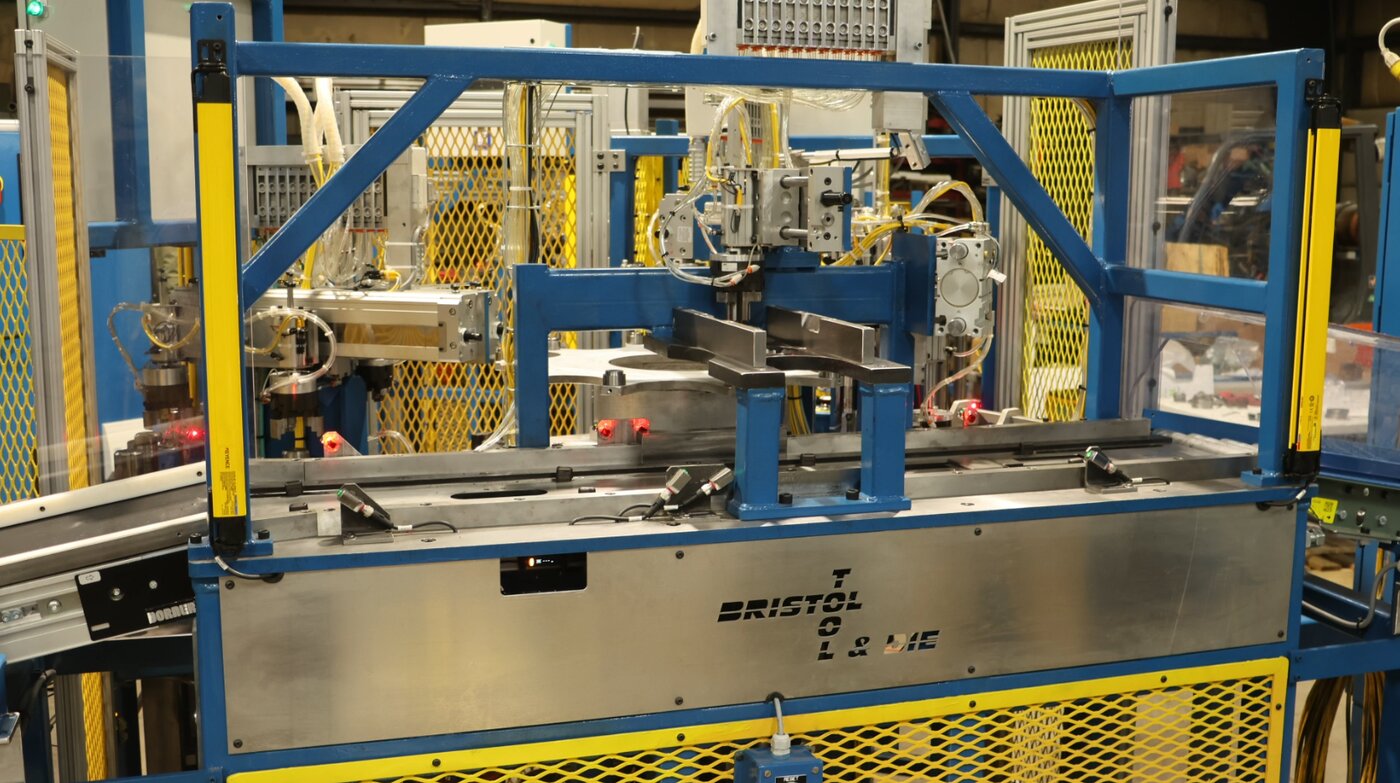
When a Tier-1 North American RV chassis and components OEM needed to take manual shackle-link assembly off the floor, the ask was simple: build something that can grow with us. The 23-station integrated cell that Bristol Tool & Die – Automation delivered has now completed more than 4,000,000 part cycles in continuous production. Labor headcount dropped from five operators over five days to three operators over three days. The machine is still running.
What Five Operators Over Five Days Actually Costs You
Manual assembly lines look manageable until you price them honestly. Five operators, five production days a week, assembling shackle links by hand — that headcount is the floor, not the ceiling. Add overtime when demand spikes, training burden when anyone turns over, scrap from fatigue-driven inconsistency, and the floor-space that five dedicated workstations occupy. Then acknowledge the harder truth: the bottleneck doesn't scale. When an RV chassis OEM's build rate increases, a manual shackle-link cell doesn't stretch to meet it. You hire a sixth operator, squeeze in a sixth station, and accept a proportional increase in all the costs you were already absorbing.
That's the position a Tier-1 North American RV chassis and components OEM was in when they came to Bristol. It wasn't a crisis — it was a slow, expensive ceiling. The challenge was removing it without introducing a new category of risk: an automation system so complex it creates its own fragility.
That concern is legitimate. The wrong solution trades labor variance for downtime variance. Manufacturers who've been burned by over-engineered cells know that a machine requiring a specialist every time a sensor trips is not an improvement on five people who know their jobs. The engineering question isn't just "can we automate this?" It's "can we build something that runs for a decade without becoming its own maintenance project?"
Why the Answer Was 23 Stations, Not Faster Fixtures
When throughput is the problem, the reflexive answer is to speed up what already exists — better tooling, faster fixtures, tighter ergonomics. That approach works when the process is sound and labor is the only variable. Shackle-link assembly isn't that process. It involves multiple discrete operations — positioning, pressing, staking, verification — that don't compress well in a manual format. Accelerating any single station just shifts the bottleneck to the next one.
An integrated cell thinks about the problem differently. Instead of asking how to make each manual step faster, it asks how to eliminate the transitions between them. Twenty-three stations means twenty-three defined process points operating in a coordinated sequence, each handing off to the next without human intervention. Cycle time isn't governed by the slowest operator on a given morning — it's governed by the design of the cell itself.
That architectural choice is the difference between productivity improvement and throughput transformation. A faster fixture lets you run harder. A 23-station integrated cell removes the variable of human pace from the equation entirely. The output becomes predictable in a way that manual assembly never is, and predictable output is what a Tier-1 supplier needs when it's coordinating production schedules with chassis assembly lines that don't wait.
It also changes the labor conversation. The three operators running this cell today are not doing what five operators were doing before — they're supervising, loading, and managing a system rather than executing repetitive manual operations. That's a better use of experienced floor personnel, and it's a more defensible staffing model as labor markets tighten.
Engineering Choices That Bought a Decade of Uptime
A machine that's been running for 4,000,000+ cycles isn't still running by accident. It's still running because specific decisions were made at the design stage that others — focused on minimizing upfront cost — don't always make.
The first is servo control architecture. Servo-driven motion gives you programmable precision on every axis, but the real value over a decade isn't accuracy at installation — it's repeatability at year eight. Mechanical wear in pneumatic systems introduces drift. Servo systems allow that drift to be corrected in software without physical rework. When your cell needs to accommodate a component revision five years after build, servo architecture means that change is a parameter adjustment, not a mechanical retrofit.
The second is sensor redundancy. Every station in this cell was designed with part-presence sensing and verification logic built into the control strategy. The machine doesn't assume a part seated correctly — it confirms it before moving to the next operation. That approach adds sensor cost at build time and eliminates a category of defect escape that haunts underdeveloped automation: parts that move through a cell in the wrong state and don't fail until they're in the field or downstream at the customer's assembly operation.
The third is PLC strategy. The control architecture was selected for long-term supportability — hardware and software ecosystems that will still have supply chain depth in year ten. This matters more than most buyers realize when they're speccing a machine. Automation built on a control platform with a three-year hardware lifecycle creates a parts-availability problem that becomes a production-continuity problem. The Bristol approach accounts for the machine's entire service life, not just its commissioning date.
HMI with part selection rounds out the controls picture. Operators interact with the system through an interface designed to present what they need and obscure what they don't. When product variants change — and in RV chassis production, they do — the machine adapts through the HMI rather than through physical reconfiguration. That operator-facing flexibility is what separates a machine that runs in production from a machine that runs in the conditions it was built for and stalls when anything changes.
Safety interlocks were integrated throughout — not added as a compliance layer at the end of the build. When safety is engineered into the cell architecture rather than bolted on afterward, it doesn't compromise cycle time and it doesn't create workarounds. Operators don't bypass interlocks that get in their way. They do bypass interlocks that were clearly added as an afterthought. The distinction matters enormously over a decade of operation.
The Numbers Don't Need Interpretation
Some results require context to land. These don't.
Before: five operators, five production days per week, assembling shackle links by hand. After: three operators, three production days per week, operating an integrated 23-station cell. That's a 40% reduction in headcount and a 40% reduction in the production-day footprint for this operation — a change that frees both people and schedule capacity without any reduction in output volume.
The cycle count tells its own story. More than 4,000,000 shackle-link assemblies have passed through this machine. At current production volumes, that represents years of continuous service without the capital event of a replacement. The machine the customer bought is the machine they're still running. There has been no mid-life rebuild, no platform swap, no obsolescence-driven replacement cycle that required another capital authorization. That kind of longevity is not industry standard — it is the result of specific engineering choices made at the design stage.
What that means financially is a true cost-per-part that continues to improve. The capital cost of the cell is fully amortized against actual production, and the ongoing cost is labor and consumables — not replacement equipment. For a Tier-1 supplier managing cost-per-unit at scale, that trajectory matters as much as the headline numbers.
The machine is still running. That phrase is the ROI summary. Every additional cycle is accretive against a capital outlay that closed long ago.
The Grease Machine: 45 Seconds to 8.5 Seconds on the Same Line
The shackle-link assembly cell was not the only bottleneck on this customer's operation. A companion grease application process was running a 45-second cycle time — long enough to pace the entire line whenever production pressure increased. A manual or semi-manual greasing operation that takes 45 seconds per unit doesn't just slow output; it creates queue pressure upstream and downstream that ripples through the schedule in ways that are difficult to trace back to a single root cause.
The Bristol-built grease machine took that cycle time to 8.5 seconds. That's a 5.3× throughput improvement on a single operation — and because that operation was a pacing constraint for the broader line, the improvement wasn't siloed to the greasing station. It relieved a systemic pressure that the customer had been managing around rather than eliminating.
The relevance to a buyer evaluating Bristol isn't just the number. It's the pattern. A one-machine relationship that addresses assembly is one kind of engagement. A relationship where Bristol understands the full production flow well enough to identify and resolve a companion constraint — that's a different kind of partnership. When a supplier understands your line as a system rather than as a collection of individual machines, the solutions compound. The grease machine improvement is inseparable from the assembly cell improvement because both of them changed what the line could do.
5.3× throughput on a pacing operation. On the same line. From the same engineering team. That's not coincidence — it's what happens when a supplier actually learns your production environment.
What This Means If You're Looking at a Similar Problem
If you're a Director of Engineering or VP Manufacturing evaluating custom automation for a repetitive assembly operation, this case has a direct message: the cheapest machine is rarely the lowest-cost machine. A cell designed to run for a decade — with servo architecture that accommodates product evolution, sensor redundancy that prevents defect escapes, a PLC platform with real supply chain depth, and safety interlocks that operators actually respect — costs more to build and far less to own.
The 4,000,000-cycle milestone is the proof point, but the mechanism is the engineering discipline behind it. Bristol's engineering bench brings over 100 combined years of experience across three engineers and two senior designers to every machine build. That depth isn't a credential — it's what produces machines that are still running when others have already been replaced.
The project scope for custom automation runs from $150K to $750K and beyond, with typical lead times of six to ten months. That range covers a wide class of problems, and the economics look different when you're pricing a machine that will run for a decade versus one you'll be replacing in three years. If you're at the stage of evaluating whether an integrated cell is the right answer for your operation, the question Bristol's team will press on is not just what you need today — it's what you'll need the machine to do in year five, when product variants have shifted and your build rate has changed.
A machine that answers year one and fails year five isn't automation. It's a temporary fix with a capital cost attached. The 23-station shackle-link cell has been answering the question for more than 4,000,000 cycles. The grease machine cut pacing time by more than five-to-one on the same line. These outcomes are repeatable — not because Bristol gets lucky, but because the engineering process that produced them is deliberate and documented.
If your operation has a manual assembly bottleneck that's capping your throughput, a companion process that's pacing your line, or an aging automated cell that's creating more maintenance overhead than it's worth, reach out directly: 574-848-5354 or 574-848-5354. The engineering team will tell you quickly whether the problem fits what they build — and if it does, what a solution looks like in real terms.
Frequently Asked Questions
Common questions about this case.
How long does it take to build and commission a 23-station custom assembly cell?
Bristol's typical lead time for custom automation is 6 to 10 months from project authorization to commissioning, depending on machine complexity and customer-supplied tooling requirements. A 23-station integrated cell with servo controls, sensor redundancy, and safety interlocks sits toward the higher end of that range, though project-specific timelines are confirmed during scoping.
What does a custom assembly cell from Bristol Tool & Die cost?
Custom automated machines from Bristol are scoped in the $150,000 to $750,000+ range depending on station count, drive architecture, control complexity, and required throughput. The 23-station shackle-link cell in this case study is a full-featured integrated build. Bristol will provide a detailed estimate after reviewing your production requirements and part geometry.
Can an older or underperforming assembly cell be rebuilt rather than replaced?
Yes. Bristol's repair and refurbishment capability covers process equipment, mechanical machines, assembly machines, and test equipment. If a cell has sound structural bones but worn drives, outdated controls, or insufficient safety features, a targeted refurbishment is often significantly lower cost than a new build — and Bristol can assess which path makes economic sense for your situation.
How does Bristol handle product variants or engineering changes on an existing automated cell?
The control architecture Bristol specifies — including HMI with part selection and servo-driven motion — is designed to accommodate variant changes through software and parameter adjustments rather than physical machine rework. For the shackle-link cell, this flexibility has allowed the machine to remain in continuous production through normal product evolution over more than 4,000,000 cycles. Significant engineering changes are evaluated on a case-by-case basis.
Ready to discuss your project?
Tell us your part, your volume, and your timeline. We’ll respond within one business day with a clear next step.