Progressive, Transfer, Compound, and Blanking Dies — Up to 14 Stations, Designed for Your Press
Progressive, transfer, compound, blanking, draw, form, trim, and pierce dies — 1 to 14 stations, tool steel A2/D2/S7/M2/CPM-10V hardened to 58–62 HRC, punch and die details to ±.0001″ on Charmilles Robofil wire EDM. Press compatibility: Stamtec, Bliss, Minster, Verson, Komatsu. Tryout on our 200-Ton Bliss before delivery.
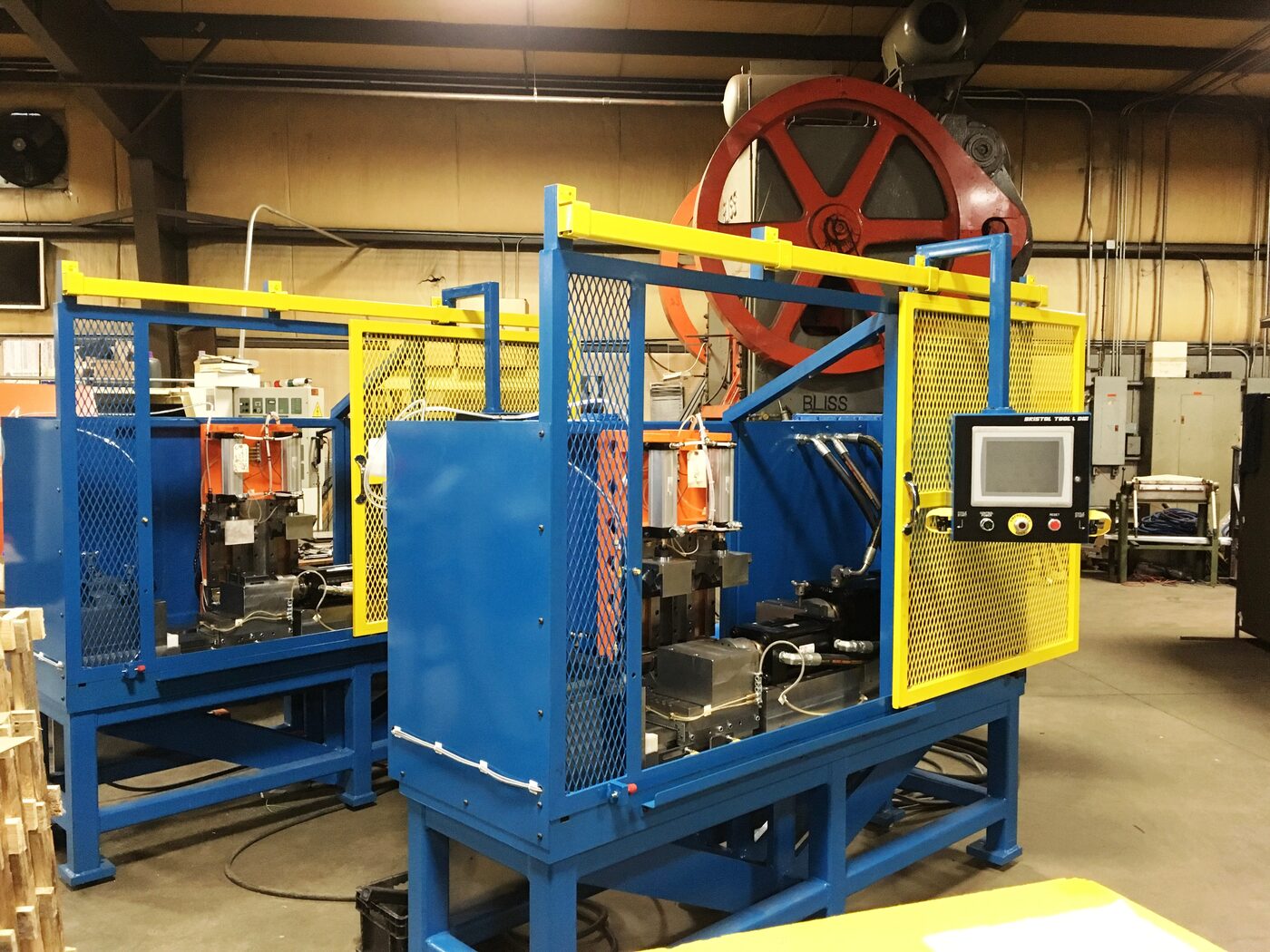
The original Bristol capability — still in production at OEMs today
The dies that ship from Bristol are still running ten years later. That is the moat. Procurement teams have been burned by tooling that needs a full rebuild inside 18 months because the original designer cut the section corner-radius too sharp or specified the wrong tool steel for the part chemistry. Bristol's dies are designed by engineers who will still be employed at Bristol when the die comes back for its first refresh — and the second. The 14-station progressive die we built with dual-direction forming has been in continuous production at an industrial OEM for over a decade. Pontoon railing tooling we designed and built supports approximately $510,000 in annual revenue across five active marine OEMs. Those aren't brochure numbers — those are programs that re-ordered.
The risk in a poorly designed die is the scale of the run in reverse: a problem found at part 50,000 is a problem on every part that came before it. Bristol's wire EDM punch and die details hold ±.0001″ on hardened tool steel. Conservative die design, right-sized tool steel, right clearances for the material chemistry — that is why our dies are still producing in-spec parts when other shops' dies are scrap.
Single-stage to 14-station progressive, $25K–$200K
- Single-station dies — piercing, blanking, drawing, or forming on dedicated press cells.
- Compound dies — multiple operations in a single station, typically blanking and piercing on the same stroke.
- Progressive dies up to 14 stations — complex parts with multiple forms, pierces, draws, and trims.
- Dual-direction forming dies — for parts that require upward and downward features in the same stroke, our specialty.
- Die repair and modification — for dies built by other shops, including reverse-engineering of components that have failed or worn out.
From print to PPAP-ready first article — under one roof
From strip layout through tryout on our Bliss 200-Ton, the entire die program runs at one address with one engineering team. The strip layout determines material utilization; the design review gate happens in CAD before any tooling is cut; punch and die details run through Charmilles Robofil wire EDM on hardened tool steel. The customer witnesses tryout at our facility. Runoff acceptance criteria are written before the build starts — not after. The die that ships has already hit spec. There is no "we'll tune it in your press" hand-wave.
Die specifications: tolerance, press capacity, materials
Equipment
- Wire EDM tolerance. ±.0001″ on Charmilles Robofil (×2) for hardened punch and die details.
- CNC tolerance. ±.0005″ typical for die plates and structural components on Hurco 3-axis.
- Surface grinding. Kent surface grinder for die surface finish and flatness on plates and tooling components.
- Tryout press. Bliss 200-Ton straight-side, used for in-shop validation before delivery.
Tool steels
- Standard grades: A2, D2, S7, M2 — selected by application (wear resistance, toughness, shock resistance).
- Premium grade: CPM-10V for high-wear punch and die details in abrasive or high-cycle applications.
- Hardness range: 58–62 HRC, achieved post-heat treat and verified before wire EDM and grind finishing.
Stamping materials commonly handled
- Carbon steel: 1010/1018 mild, 1045 medium-carbon; hot-rolled and cold-rolled in production.
- Alloy steel: 4140, 4340 for structural and load-bearing stampings.
- Stainless steel: 17-4 PH, 316L, 300- and 400-series; 17-4 PH and 316L for precision medical work.
- Aluminum: 6061-T6 (structural), 6063-T5 (decorative profiles), A36 structural.
Press compatibility
Bristol designs dies to the customer’s press: Stamtec, Bliss, Minster, Verson, Komatsu — provide press brand, bed dimensions, shut height, stroke, and SPM with your RFQ for accurate station-count and shut-height engineering.
Every die type Bristol delivers
If it runs in a stamping press, we have built it. The list below is what ships from our Bliss 200-Ton:
- One hit dies — single-station for piercing, blanking, or forming operations.
- Interchangeable dies — modular tooling for multiple part configurations on one press.
- Transfer and line dies — for parts requiring multiple stations with part transfer.
- Two out dies — simultaneous production of two parts per stroke to reduce scrap rates.
- Cutoff, Coining, Drawing, Embossing — precision forming operations in single or progressive configurations.
- Extrusion Cutoffs — tight-tolerance cut-to-length for solids, tubing, semi-hollows, L-shapes, U- and H-channels, multi-void hollows.
- Forming, Lancing, Notching, Piercing, Punching, Trimming/blanking — standard progressive die operations up to 14 stations.
Die Repair & Refurbishment — fast turnaround, no original drawings required
When a die shows wear or dimensional drift, the cost is on every part the press produces until it's fixed. Bristol rebuilds worn dies — including dies built by other shops — quickly, and we tell you what failed and why. Typical turnaround: 2 to 6 weeks depending on scope and availability.
- Component replacement — punches, matrices, springs, lifters, and retainers.
- Diagnostics — identify root cause of failure or dimensional drift before recommending repair scope.
- Sharpening — punch and die land restoration to spec.
- Troubleshooting — strip feed issues, burr, slug pulling, misfeeds.
- Hard Welding — worn or chipped details built back up and re-machined.
- Refurbishment — full die overhaul for extended service life.
Repair work is accepted for dies built by other shops; no original drawings required.
Dies built by Bristol: still running 10+ years later
Bristol dies are in active production at RV-industry stamping operations, pontoon and marine OEMs across North America, automotive Tier-2 and Tier-3 suppliers, and industrial OEMs nationwide. A 14-station progressive die we built with dual-direction forming has run continuously at an industrial OEM for over a decade. Pontoon railing tooling we designed supports approximately $510,000 in annual revenue across five active marine OEMs.
10+ years in production without a full rebuild is not luck. It is design conservatism: right corner radii, right tool steel for the material chemistry, right clearances, right construction. You will not get a discovery call from us at month 18 telling you the die needs a rebuild we should have designed out in month one.
Frequently Asked Questions — Progressive Stamping Dies
What buyers, engineers, and procurement teams want to know before quoting a Progressive Stamping Dies project.
How much does a progressive stamping die from Bristol cost?
Progressive die builds at Bristol Tool & Die – Automation typically range from $25,000 to $200,000 depending on:
- Station count (single-station to 14-station progressive)
- Part complexity, including dual-direction forming or in-die assembly features
- Material gauge and hardness
- Cycle-life requirement (millions of parts vs. hundreds of thousands)
- Tolerance requirements on critical features
Single-station and compound dies often run in this range. Large progressive dies for thick-gauge structural parts can exceed it.
What is the typical lead time for a new progressive die?
Typical lead time from purchase order to tryout is 8 to 20 weeks depending on station count and complexity.
- Single-station and compound dies: 6–10 weeks
- 4–8 station progressives: 10–14 weeks
- 10–14 station progressives with dual-direction forming: 16–20 weeks
Lead time includes engineering, design review, tooling manufacture, assembly, bench tryout, and press tryout on our Bliss 200-Ton.
What is the tightest tolerance Bristol can hold on die components?
Punch and die details produced on our Charmilles Robofil wire EDM hold tolerances to ±.0001 inch on hardened tool steel. Standard CNC-machined die plates and structural components hold ±.0005 inch typical.
These are the tolerance capabilities on the equipment. Specific projects are quoted against actual print requirements and gauge methods.
Can Bristol repair or modify a die built by another shop?
Yes. Die repair and modification is a regular part of our business:
- Rebuild worn or damaged punch and die details
- Replace springs, lifters, and stripper components
- Modify station geometry to accommodate part design changes
- Reverse-engineer details from dies where original drawings are unavailable
- Convert dies between presses
Typical repair turnaround is 2 to 6 weeks depending on scope and availability. We will inspect the die at our facility and provide a written recommendation.
What materials and gauges do Bristol dies typically run?
Bristol-built dies routinely produce parts in:
- Mild steel: hot rolled and cold rolled, common automotive and RV grades
- HSLA (high-strength low-alloy) steels
- Stainless steel: 300-series and 400-series
- Aluminum: 5052 and 6061 most common
- Copper alloys for electrical and conductive components
Thicker or more exotic materials are evaluated on a project-specific basis.
Does Bristol provide first-article inspection and runoff documentation?
Yes. Our quality process for every new die includes:
- First-article inspection with measured dimensions documented against the part print
- Customer-witnessed press tryout on our Bliss 200-Ton available for any project
- Runoff acceptance criteria agreed in writing before the die is built — not after
- Documented die book delivered with every die, including station drawings, spare parts list, and maintenance guidance
Quality is governed by documented internal process and 25 years of die outcomes still in production.
Industries using Progressive Stamping Dies
The same capability serves different industries differently. These pages show how this discipline is applied for specific buyer types and project profiles.
Ready to discuss your project?
Tell us your part, your volume, and your timeline. We’ll respond within one business day with a clear next step.