The Midwest RV Supply Chain Cluster and What It Buys Sourcing Teams
Nearly 88% of all RVs built in North America come out of Indiana — and most of them out of a corridor smaller than many metro commutes. For sourcing directors, that concentration isn't just a trivia point. It reshapes lead times, change-order velocity, and what you should actually require of a tooling or automation partner.
One County, Most of an Industry
The numbers have been cited enough that they risk becoming background noise, but they deserve a close read. According to the RVIA's 2025 Industry Profile, Indiana manufactures 88 percent of all recreational vehicles built in the United States and Canada. Wholesale shipments for the year totaled 342,220 units with a retail value of $20.40 billion. The WSBT reporting on Elkhart County puts it plainly: the county produces "nearly 80% of the global RV supply" — and the bulk of Indiana's output is concentrated in Elkhart County and immediately adjacent towns like Goshen, Middlebury, and Nappanee.
This is not a coincidence of history that persists on inertia. It is an actively reinforcing industrial ecosystem. As Trade Only Today documented in depth, OEMs based in the region explicitly cite proximity to the supply chain as a reason for staying — and report that manufacturers who relocate out of the Elkhart area consistently struggle to source wiring harnesses, glass, and specialty fabricated components. The cluster feeds itself: dense supplier networks reduce component lead times, which allow faster model iteration, which drives more production into the region, which attracts more suppliers.
Major RV OEMs — Thor Industries, Forest River, Winnebago, REV Group, and Gulf Stream Coach among them — are headquartered or maintain primary manufacturing operations in this corridor. The Bureau of Labor Statistics counts manufacturing employment in Elkhart County at approximately 61,000 workers as of mid-2025, according to BLS data tracked by RV market analysts. That workforce depth — specialized in assembly, fabrication, and precision component work — is itself part of what makes the cluster sticky.
For any sourcing professional buying tooling, dies, or custom automation into an RV or chassis OEM, this concentration has direct operational consequences.
What Cluster Proximity Actually Buys in Tooling and Automation
RV program schedules move fast. Model-year changes, platform refreshes, and mid-cycle engineering corrections generate a volume of tooling change orders that would be unremarkable at an auto OEM but can be genuinely disruptive for smaller shops without the engineering depth to absorb scope shifts quickly.
When a tooling or automation supplier operates inside the same industrial corridor as its RV customers, several friction points compress:
- On-site engineering access. A design review that would require a two-day travel commitment from a distant vendor becomes a same-day or next-day site visit. When a line engineer identifies a forming issue on a new die or a sensor conflict on an assembly cell, resolution time is measured in hours rather than weeks of back-and-forth documentation.
- Change-order velocity. Platform modifications in the RV industry don't wait for quarterly review cycles. A supplier close enough to put engineering eyes on the problem — and hands on the machine — within 24 hours can absorb changes that would otherwise stall a production line.
- Prototype and tryout loops. For progressive stamping dies, the tryout phase is iterative by nature. Geographic proximity shortens the sample-to-feedback loop, reducing the number of trial cycles required before a die ships to production.
- Relationship density. In a concentrated industry, the same engineering contacts rotate between OEMs and Tier-1 suppliers over careers. Suppliers embedded in the cluster carry institutional knowledge of the industry's quirks — chassis tolerances, material preferences, production-floor constraints — that remote shops have to learn from scratch on every new program.
These are not soft benefits. They show up in first-article approval rates, in line qualification timelines, and in the total cost of a program when change orders are handled inside the original contract rather than triggering expensive amendments.
Why Proximity Is Not the Whole Story
Here is where sourcing directors should think carefully. Geographic proximity is a logistical variable. It is not a capability credential.
An automation builder or tooling shop that happens to sit inside the RV cluster is no more qualified by location than a supplier in another state is disqualified by distance. What the cluster creates is an advantage in responsiveness — one that a capable national supplier can replicate through engineering bandwidth, dedicated program management, and deliberate investment in customer access. And the reverse is equally true: a local shop without the engineering depth, equipment precision, or production continuity to deliver on complex programs offers the proximity advantage without the actual value.
Bristol Tool & Die – Automation ships custom automation platforms and precision tooling to customers across the country. The $510,000-per-year marine platform built for three separate OEMs — a hydraulic railing bender used for pontoon railings — has been in continuous production for over ten years. Those customers are not all located in the same county. The 14-station progressive die with dual-direction forming that has been running for over a decade at an industrial OEM is not a regional relationship. National capability is the expectation, not the exception.
Bristol's facility is in Bristol, Indiana — squarely inside the northern Indiana manufacturing corridor. That means the cluster's logistical benefits are real and available to RV and chassis OEM customers. But sourcing decisions should never be driven by a radius. They should be driven by engineering depth, equipment capability, production track record, and the supplier's ability to absorb program complexity without flinching.
What a National RV Sourcing Director Should Take From This Concentration
The 88-percent production concentration in Indiana is not just an industry curiosity. It carries strategic implications for how sourcing teams should think about their tooling and automation supply base.
Concentration creates shared risk. When the majority of North American RV production depends on suppliers clustered in a small geographic footprint, a regional disruption — weather, labor shortage, a single supplier's capacity constraint — can ripple across multiple OEM customers simultaneously. The COVID-19 shutdowns in spring 2020 demonstrated this concretely: Elkhart-area plant closures effectively paused a substantial portion of national RV output. A sourcing director who has diversified their tooling relationships beyond a single cluster-dependent vendor pool carries lower supply continuity risk.
Cluster suppliers are not automatically cluster-optimized. The density of vendors in northern Indiana creates competition, which benefits buyers — but it also creates a long tail of shops that serve the cluster without the engineering capability to take on complex programs. Evaluating a tooling or automation vendor on program history, cycle counts, and on-time delivery data matters more than evaluating on geography.
The cluster's supply chain depth is a resource, not a limitation. A sophisticated supplier embedded in the cluster can leverage its supplier relationships, its knowledge of regional material flows, and its familiarity with RV OEM production rhythms — and apply that accumulated knowledge equally to customers in other markets. That is the correct model for a national industrial supplier: rooted in the cluster, not restricted to it.
How Bristol's Position Inside the Cluster Shows Up in Real Programs
Two programs illustrate what cluster-embedded capability looks like in practice — at scale, with production continuity as the proof point.
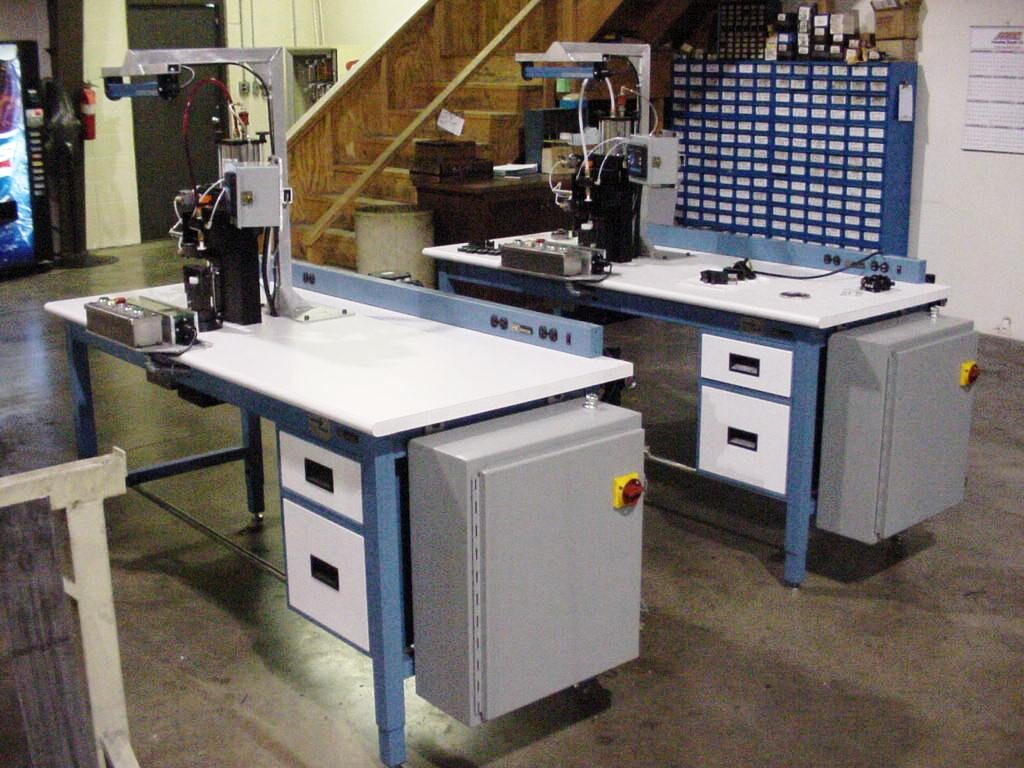
The 23-station shackle-link assembly cell. Built for a Tier-1 North American RV chassis and components OEM, this custom automation platform has logged over 4,000,000 part cycles in continuous production. The labor model shifted from five operators working five days to three operators working three days — a compression in both headcount and schedule that directly affects the customer's cost per unit. A system running at that cycle volume, without replacement, is the practical definition of a program delivered right. The engineering team that built it, and the precision machining capability that made the tooling components hold tolerance across millions of actuations, is still here.
The hydraulic railing bender platform. This platform serves three separate marine OEMs, producing pontoon railings to consistent dimensional spec across a production run now exceeding ten years. Combined annual revenue across the three customers is approximately $510,000. That one platform — designed, built, and supported from Bristol — has generated more than $5 million in customer value over its operational life. Multi-OEM deployments of the same engineered platform are only possible when the original design is precise enough, robust enough, and well-documented enough to transfer across customers without re-engineering from scratch.
Both programs reflect what the cluster's best suppliers can offer: engineering depth developed through proximity to demanding OEM customers, production equipment capable of holding the tolerances that modern RV chassis and marine component programs require, and the organizational discipline to keep a program running years after delivery.
The Sourcing Calculus
For a sourcing director buying tooling or automation into the RV supply chain, the cluster's concentration is context. It tells you where the industry lives, what the competitive dynamics look like, and why certain suppliers have developed capabilities that others haven't. It does not tell you which supplier is the right partner for a specific program.
The right questions remain the same regardless of geography: How many programs at comparable complexity have they delivered? What do those systems look like after 4 million cycles? Can they absorb a scope change mid-build without triggering a full re-quote? Do they have the engineering bench to staff your program without pulling resources from someone else's?
A supplier who happens to be positioned inside the world's most concentrated RV manufacturing cluster — and who can answer those questions with documented production history rather than a capabilities brochure — is a different asset than proximity alone.
Frequently Asked Questions
Common questions about this topic.
What percentage of U.S. RV production is concentrated in Indiana?
According to the RVIA's 2025 Industry Profile, Indiana manufactures 88 percent of all recreational vehicles built in the United States and Canada, with the majority of that output concentrated in Elkhart County and the surrounding northern Indiana corridor — towns like Goshen, Middlebury, and Nappanee.
Does Bristol Tool & Die – Automation exclusively serve customers in the Elkhart County RV cluster?
No. Bristol serves a national customer base across RV, marine, defense, and industrial manufacturing sectors. Bristol's facility is located in Bristol, Indiana — inside the northern Indiana manufacturing corridor, which provides logistical advantages when serving RV OEMs — but Bristol designs, builds, and ships custom automation platforms and precision tooling to customers throughout the country. Geographic proximity to the cluster is one advantage among several Bristol brings to a program.
Why does RV manufacturing cluster so heavily in northern Indiana?
The concentration is self-reinforcing. A dense supplier network reduces component lead times, which supports faster model iteration, which attracts more production to the region, which draws more specialized suppliers. As reported by Trade Only Today, major RV OEMs explicitly cite proximity to suppliers — wiring harnesses, glass, axles, specialty fabrications — as a primary reason for remaining in Elkhart County. Manufacturers who relocate out of the area consistently report difficulty sourcing the same components reliably.
What should sourcing directors actually evaluate when selecting a tooling or automation supplier for an RV program?
Geography is context, not a credential. The critical evaluation criteria are: documented program history at comparable complexity, production cycle counts and uptime data on delivered systems, engineering bandwidth to absorb scope changes mid-program, and precision machining capability sufficient to hold tolerance across high-cycle production. A supplier embedded in the northern Indiana cluster who can answer those questions with production data — not just a capabilities list — represents a materially different risk profile for a sourcing team than one who trades on proximity alone.
Ready to discuss your project?
Tell us your part, your volume, and your timeline. We’ll respond within one business day with a clear next step.