The Same Team. The Same Floor. Twenty-Five Years of Work Still in Production.
Bristol Tool & Die – Automation has shipped progressive dies, custom automated machines, and precision components out of one Indiana facility since 1999 — through two recessions, the COVID disruption, and the EV-transition turbulence that broke a lot of single-platform shops. The reason customers come back for the next die and the next cell is that the previous one is still running, supported by the same engineers and tool-makers who built it. In 2026 the brand becomes Bristol Tool & Die – Automation to match what the business already is.
The supplier you want is the one still answering the phone in year fifteen
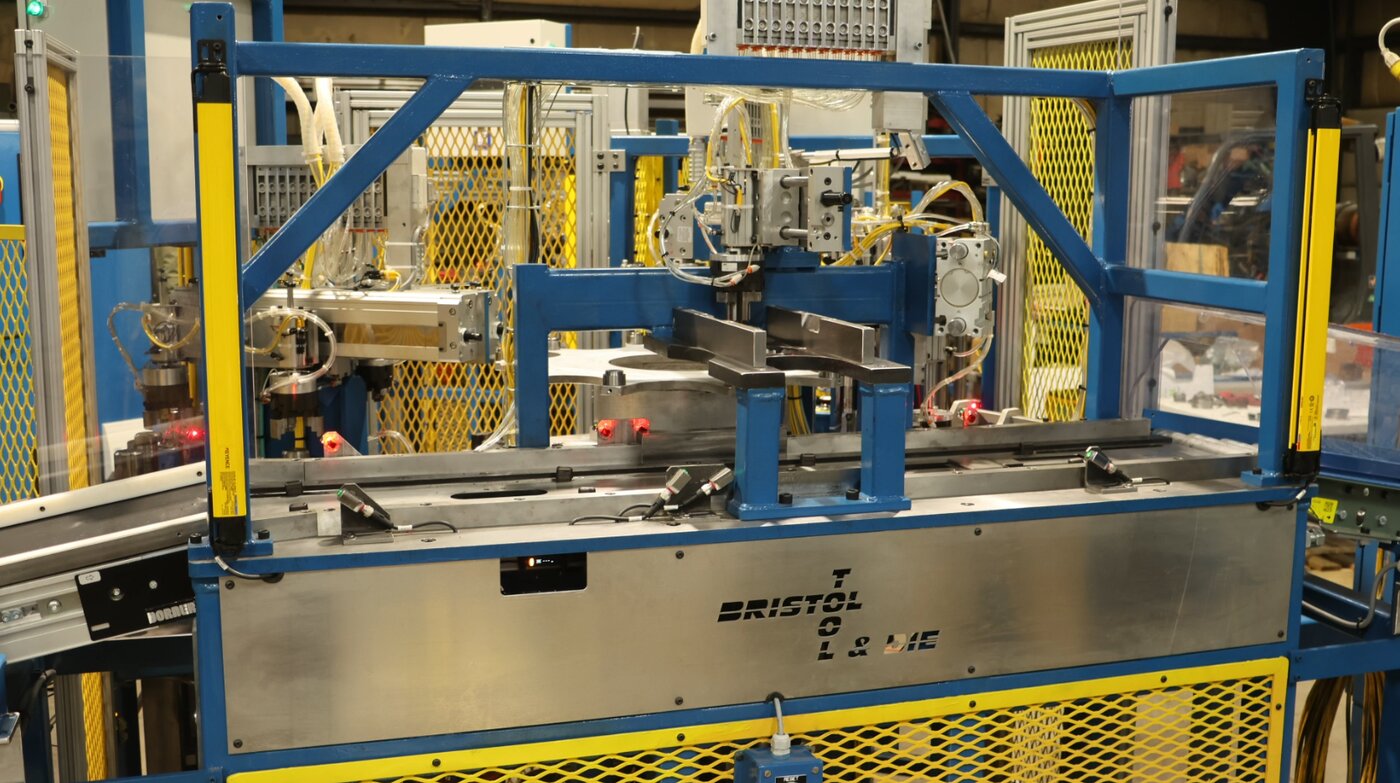
Industrial buyers don’t pick tooling and automation partners on capability decks. They pick them on the boring question that decides whether a $500,000 cell is a 10-year asset or a three-year regret: will the people who built this still be here when the part changes, the controls drift, or the tool comes back for refresh? Twenty-five years of Bristol-built dies and machines are still answering that question in production today — built by an engineering and tool-making team that, in most cases, is still on the floor at 689 Commerce Drive.
The legal entity is Bristol Integrated Tooling and Automation LLC. In 2026 the brand becomes Bristol Tool & Die – Automation — an honest description of what the business has been for the last decade: an integrated shop where progressive dies, custom automation, precision machining, wire EDM, waterjet, controls, pontoon rail benders, and extrusion fabrication equipment come off the same floor, one team, on the same PO. The phone number is the same. The address is the same. The team is the same.
Veteran-owned, owner-led — no holding company between you and the work
Bristol is owned and led by Charles Reitsma, a former U.S. Air Force Captain. The company carries Veteran-Owned Small Business status with an active path to SDVOSB. Roughly 20% of the workforce are veterans. There is no private-equity owner, no holding company, no rotating GM — the person making the strategic call on your program is the person who owns the company.
In Charles’s own words — why he owns and leads Bristol
“After serving in Air Force acquisition, I noticed that ‘supply chain resiliency’ in acquisitions wasn’t really practiced. Every component seemed to have some thread back to manufacturing in Communist countries, where freedom exists so long as you believe what others tell you to and where dissidents are punished. As a US citizen and Air Force officer who signed up to give his life for the cause of freedom, I know that the US has been a beacon of hope for freedom. I felt compelled to be part of the resurgence of manufacturing in the United States and to rebuild to be able to protect those freedoms against all who would challenge them. Wars aren’t won simply by having enough people, but by having the ability to replenish resources. I wanted to build my part in protecting freedoms for all people through manufacturing.”
— Charles Reitsma, CEO, Bristol Tool & Die – Automation
170+ combined years of engineering and design — not on a roster, on the floor
The reason a Bristol die or cell still runs in year ten is not a binder on a shelf. It is the engineer who saw the same failure mode on a different program in 2008 and designed it out before the print left the office. That kind of pattern recognition does not appear on a resume.
- Three engineers on staff — 100+ combined years (40 + 40 + 20).
- Two senior designers on staff — 70+ combined years (40 + 30).
Design problems get caught before metal is cut. Field issues get resolved on the first phone call. That is what the bench is for.
One Indiana facility, seven capabilities, no subcontractor inside the bill of materials
Everything Bristol delivers comes off a single floor at 689 Commerce Drive in Bristol, Indiana — engineering offices, Hurco 3-axis CNC, CNC lathes, two Charmilles Robofil wire EDMs (±.0001″), OMAX 10′×20′ abrasive waterjet, Lucas horizontal boring mill, Kent surface grinder, Bliss 200-Ton tryout press, and dedicated runoff space for full automation builds. Bristol builds the machines and tooling in-house; it is not a structural fabricator. Site visits are welcome and expected on substantial programs — the floor is the credential.
The proof is what is still running
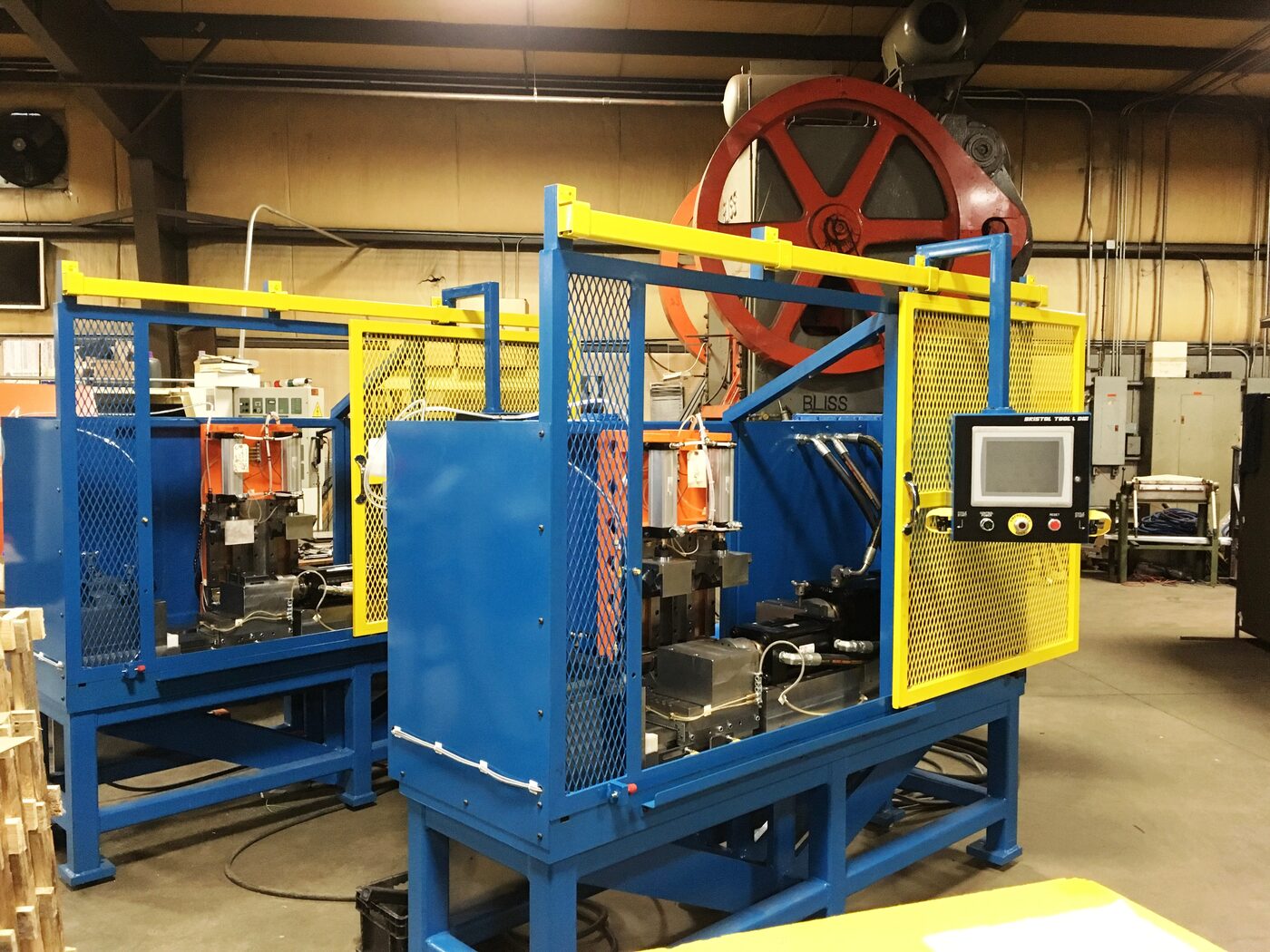
The work below is the answer to every “can you actually do this?” question a procurement team asks. Customers are anonymized for confidentiality; named references are available during qualification under NDA.
- 23-station shackle-link assembly cell — Tier-1 RV chassis OEM. Past four million part cycles in continuous production. Labor: 5 operators/5 days reduced to 3 operators/3 days.
- Grease machine for the same OEM. Cycle time pulled from 45 seconds to 8.5 seconds — a 5.3× throughput improvement on a high-volume station.
- Arm-bar press platform — leading trailer-axle and suspension manufacturer. Described by the OEM’s engineering leadership as “the heart and soul of their suspension line.”
- Hydraulic railing bender platform — five marine OEMs. Bristol builds the bending machines; the OEMs weld their railings at their own facilities. 20+ years in continuous production, approximately $510,000 in combined annual revenue across the platform.
- Defense fixture program — U.S. defense prime contractor headquartered in Indiana. Precision fixture builds completed under federal flow-down. Written commendation from the prime’s quality and program leadership on the government inspection.
- Rail bender — U.S. industrial electrical OEM. Designed, built, and delivered ahead of schedule on a critical program.
- 14-station progressive die with dual-direction forming. Ten-plus years in continuous production at an industrial OEM.
Machines and dies built in the early 2000s by the same engineering and tool-making team are still in field service today — supported by the same shop that built them. That is the only continuity story that matters to a buyer.
Quality discipline that holds up to a prime contractor’s audit
Bristol’s quality discipline is the reason a die runs ten years without a rebuild and delivered cells continue performing as intended. The system the floor actually runs:
- Documented design review, build, inspection, and customer acceptance on every program.
- First-article inspection on every new die station and every new precision part — dimensions documented against print.
- Runoff acceptance criteria signed by the customer before build starts, never after.
- A 25-year continuity record measured on the shop floor in parts and machines that are still producing.
The credentials a prime or OEM procurement team needs to see — all current
Frequently Asked Questions — About the Company
What buyers, partners, and prospective employees ask about Bristol Tool & Die – Automation.
How long has Bristol Tool & Die been in operation, and what is the company's history?
Bristol Tool & Die has been in production since 1999 in Bristol, Indiana, originally focused on progressive stamping dies for the recreational vehicle and trailer industry.
Over 25 years the company has expanded into custom automated machine design and build, CNC machining, wire EDM, waterjet cutting, controls integration, and extrusion tooling.
In 2026 the company is rebranding to Bristol Tool & Die – Automation to reflect the integrated tooling-and-automation business it has become. The legal entity is Bristol Integrated Tooling and Automation LLC.
Who owns and leads Bristol Tool & Die – Automation?
Bristol is owned and led by Charles Reitsma, a former U.S. Air Force Captain with a career in defense acquisition.
The company is veteran-owned (VOSB) with an active path toward Service-Disabled Veteran-Owned Small Business (SDVOSB) designation. Approximately 20% of the workforce is veterans.
The leadership team includes engineering, operations, and project management depth built over the company's 25-year history.
How many employees does Bristol have, and what is the team's experience profile?
Bristol operates with an 11- to 50-person team, the majority of whom are engineers, machinists, die makers, and fabricators with industry tenure measured in decades rather than years.
The shop has multi-decade veterans on the floor whose pattern recognition is a substantial part of the company's value to customers — the kind of experience that catches design problems before they leave the engineering office and that resolves field issues on the first phone call.
Approximately 20% of the workforce is veterans.
What does Bristol's facility look like, and where is it located?
Bristol Tool & Die – Automation operates from a single facility at 689 Commerce Drive, Bristol, IN 46507.
The facility houses:
- Engineering offices
- Machining cells: Hurco 3-axis CNC, CNC lathes, Charmilles Robofil wire EDM (x2), OMAX abrasive waterjet
- Bliss 200-Ton straight-side tryout press
- Kent surface grinder and Lucas horizontal boring mill
- Fabrication and weld cells
- Dedicated runoff and assembly space for custom automation builds
Site visits are welcomed and a typical part of the project qualification process for substantial builds.
How has Bristol survived 25 years of economic and industry change?
Three structural choices:
- A multi-discipline capability stack that doesn't depend on any single industry's cycle — when RV softens, automotive picks up; when automotive is slow, marine retool work fills capacity.
- An Indiana facility serving a national customer base — geographic proximity is a real advantage for nearby customers, and the same engineering discipline delivers for customers across the U.S.
- A customer-relationship model built on continuity rather than transaction. Bristol's customers tend to come back for the next die, the next automation cell, the next retrofit, because the work delivered on the previous project held up.
The 2001 recession, the 2008–2009 recession, the COVID supply chain crisis, and the EV-transition turbulence have each tested that structure. The business is still here.
Ready to discuss your project?
Tell us your part, your volume, and your timeline. We’ll respond within one business day with a clear next step.