The Heart and Soul of a Suspension Line
A leading North American trailer-axle and suspension manufacturer runs suspension components through a single press platform. Their engineering leadership calls it "the heart and soul of their suspension line." Bristol Tool & Die built it — and built it to stay running.
The Press That Can't Stop
There is a class of manufacturing asset that sits at a different risk level than everything else on the floor. Not because it is the most complex, or the most expensive, or the hardest to maintain — but because it is the constraint. Every station upstream is feeding it. Every station downstream is waiting on it. When it stops, the line stops. When the line stops, shipments slide, schedule promises break, and customer relationships absorb the cost.
In a trailer-axle and suspension plant, that asset is often the arm-bar press — the platform that forms and presses torsion arm components into the suspension geometry the axle will carry for the life of the trailer. The tolerances are tight because they have to be. The cycle counts are high because demand is high. And the uptime expectation is, for all practical purposes, continuous.
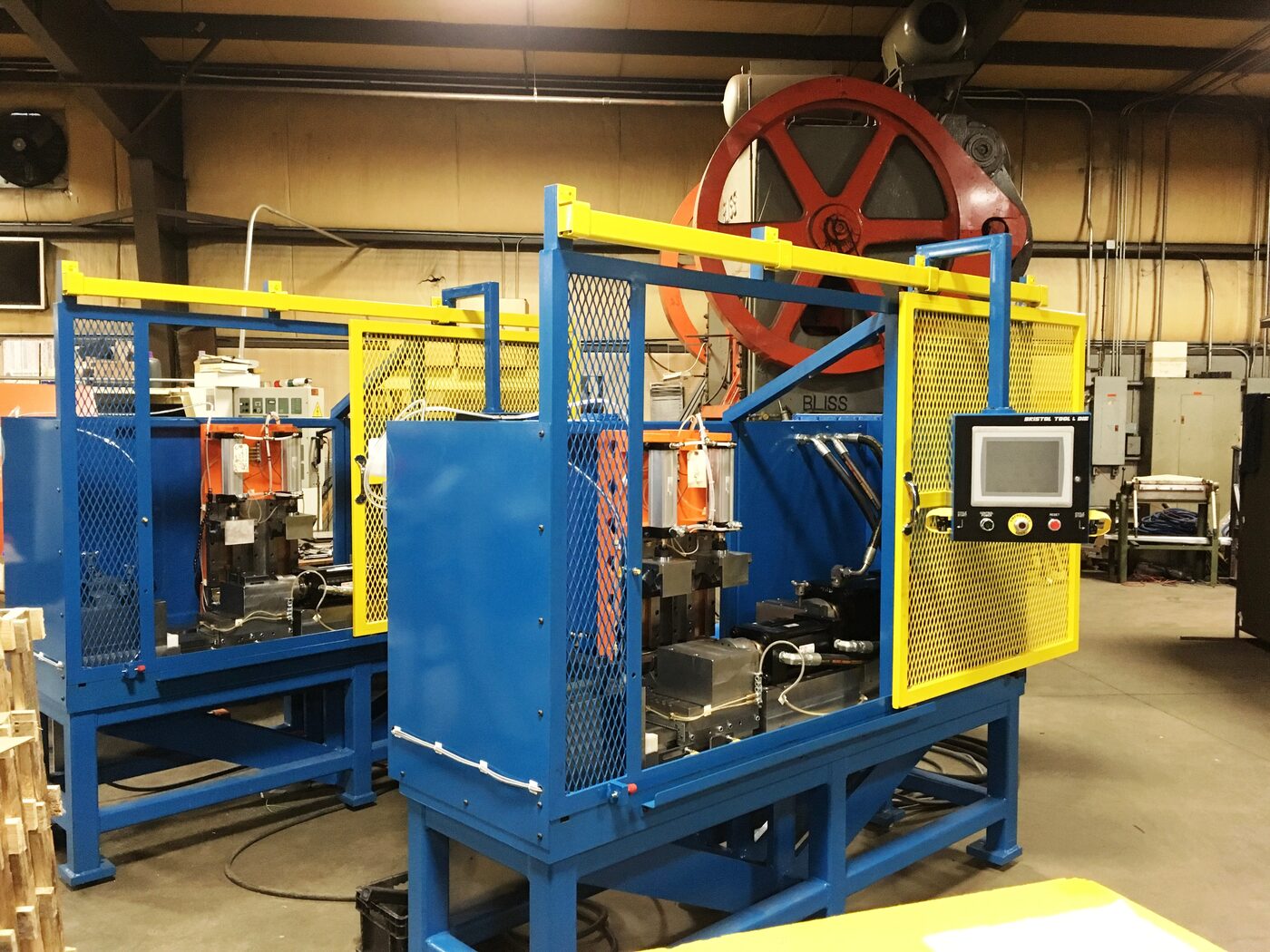
When a leading North American trailer-axle and suspension manufacturer needed to build that platform, they brought the program to Bristol Tool & Die. When it went into production, their engineering leadership described it simply: "the heart and soul of their suspension line."
That phrase is not marketing. It is a load-bearing engineering statement. It says: this platform runs the line, and the line cannot run without it.
What "Heart and Soul" Actually Costs When It Goes Down
It is worth pausing on the throughput math, because it is the math every sourcing director and VP Manufacturing already knows — and it is the math that makes a press platform like this one non-negotiable to get right the first time.
A trailer-axle and suspension line running multiple shifts is not producing trailers in small batches. North American trailer production has tracked in the hundreds of thousands of units per year across the industry, and a leading manufacturer's share of that output represents a relentless daily drum. Suspension components — torsion arms, torque tubes, axle beam interfaces — must flow at pace. A single-platform bottleneck that loses two hours on a three-shift day does not recover that output. It pushes into overtime, pulls forward maintenance windows, and compresses the schedule buffer that protects against the next disruption.
At the component level, the arm-bar and torsion arm geometries formed on a press like this are dimensional inputs to every downstream assembly operation. Suspension alignment specs, bearing seat fits, brake flange positions — they all trace back to what the press produced. When a platform drifts out of spec, it does not usually announce itself loudly. It announces itself in downstream rejects, in assembly rework, in field warranty claims that arrive months after the root cause has been papered over.
This is why the framing matters: calling a press platform "the heart and soul of the line" is not hyperbole. It is an engineer's compressed acknowledgment that the whole downstream quality and throughput story originates at this machine. The platform has to hold its geometry, hold its cycle time, and hold its uptime — simultaneously, indefinitely.
Engineering the Platform: Hydraulics, Fixturing, and Control Architecture
Building a press platform for a production-critical application is not primarily a mechanical challenge. The mechanical envelope — tonnage, stroke, bed size — is the starting point, not the deliverable. The deliverable is a system that produces correct parts, at rate, reliably, across the full service life of the platform. That system has three interdependent layers: the hydraulic architecture, the fixturing strategy, and the control architecture. Getting any one of them wrong degrades the other two.
Hydraulic Architecture
For a torsion arm press application, the hydraulic envelope governs both the force consistency and the positional repeatability of every stroke. Bristol's custom machine capability spans AC/DC drives, servo controls, and full proportional hydraulic systems — and on a platform where dimensional outcomes are the primary quality metric, proportional control is not a luxury. It is the mechanism that keeps stroke-to-stroke variation inside the tolerance band that downstream assembly depends on.
Proportional systems allow the force and velocity profile of each press cycle to be tuned and held precisely, which matters specifically in torsion arm applications where material spring-back and forming force interact. A fixed-pressure system that runs the same stroke at every cycle will accumulate dimensional variation across temperature, material lot, and tool wear in ways that proportional control can actively manage.
Fixturing Strategy
Fixturing on a production press platform is where dimensional control actually lives. The hydraulics deliver force. The fixtures deliver location. If the part is not presented to the tooling in exactly the same position, at exactly the same orientation, on every cycle, the hydraulic system's precision is wasted — the variance has already been introduced before the ram moves.
Bristol carries 25-plus years of fixture and jig work across assembly holding fixtures, weld jigs, and precision check fixtures. On the arm-bar press platform, that experience translates directly: the fixturing strategy has to account for part-to-part variation in incoming blanks, thermal expansion of the fixture body across a full production shift, and the operator interface — how quickly and consistently an operator can load and locate a part before the cycle initiates.
Bristol's jig and fixture work is also informed by its precision machining capability. The Charmilles Robofil Wire EDM systems hold ±0.0001-inch accuracy, which means fixture details, locating pins, and nest features can be machined to the tolerances that actually govern suspension geometry — not rounded to the nearest shop standard.
Control Architecture
A production-critical press platform needs a control architecture that does three things well: it enforces the process (no cycle outside parameters), it provides the operator interface that sustains throughput (part selection, recipe management, clear fault logic), and it generates the data that maintenance and engineering need to manage the platform across its service life.
Bristol integrates PLC controls with HMI touchscreens that support part selection and recipe recall — which matters on a platform that may run multiple arm-bar variants across a single shift. When a recipe change takes three minutes instead of thirty, changeover is no longer a throughput event. It is a routine transition.
Fault logic and alarm architecture are equally important. A press platform that goes down without clear fault identification costs time twice: once in the downtime itself, and again in the diagnostic work required to identify root cause. Bristol's control builds are designed to surface the fault, not just the symptom.
The 200-Ton Bliss and Why It Changes the Risk Conversation
The most expensive moment in any custom press platform program is the moment the customer discovers a problem on their floor. By that point, the machine has been shipped, installed, and commissioned. The customer's line has been scheduled around it. The tooling has been set. And the problem — whatever it is — has to be solved in a production environment, on production time, with production pressure applied to every decision.
Bristol owns a Bliss 200-ton straight-side tryout press. That asset exists specifically to eliminate that scenario.
Before the arm-bar press platform ships, Bristol can run production-representative cycles in Bristol's own shop. Not simulated cycles. Not single-stroke proof runs. Full production cycling, under load, with the actual tooling, actual fixturing, and actual control logic that will run on the customer's floor. If there is a dimensional drift issue, it surfaces in Bristol. If there is a fixturing interaction with a specific part geometry, it surfaces in Bristol. If the control recipe logic has an edge case that only appears after extended cycling, it surfaces in Bristol.
This matters specifically for a platform that a customer will describe as "the heart and soul of the line." A machine at that position in the production architecture cannot afford a learning curve after installation. The customer's engineering team is not available to babysit a commissioning process; they are running a line. The expectation — the only acceptable expectation — is that the platform arrives validated and ready to run.
The Bliss 200-ton is how Bristol can make that commitment credibly. It is not a sales claim. It is a physical asset in Bristol's shop that any customer is welcome to witness being used on their program before shipment.
For a sourcing director evaluating custom press platform vendors, this is a differentiating question worth asking directly: where do you validate? If the answer is "on your floor during install," the risk profile of that program is fundamentally different than if the answer is "in our shop, on our press, before the truck is loaded."
What It Took to Earn "Heart and Soul"
Engineering leadership at a leading manufacturer does not reach for language like "the heart and soul of our suspension line" casually. That is the phrase a senior engineer uses when a platform has earned it — when it has run long enough, reliably enough, and consistently enough that the organization has stopped thinking about it as a risk and started thinking about it as infrastructure.
Getting there requires more than a technically correct machine. It requires a vendor relationship that supports the platform across its operating life. Bristol's repair and refurbishment capability is part of that story: the ability to replace worn items, repair broken details to like-new condition, test and reuse existing components, and add safety features as requirements evolve. A press platform that runs for years will need service. The question is whether the original builder is still the right call when that moment comes — or whether the customer is on their own.
Bristol was founded in 1999 and has been building and supporting custom automation since then. The engineering bench — three engineers with over 100 combined years of experience, plus two senior designers with 70-plus combined years — is the same team that builds the platforms and the same team that supports them. There is no handoff to a separate service organization. There is no knowledge gap between who built it and who is on the phone when something needs attention.
That continuity is part of what makes a "heart and soul" outcome achievable. A press platform that the customer trusts absolutely is a press platform where every prior interaction — the build, the validation, the install, the first service call — reinforced confidence rather than eroded it. Trust at that level is not built in a single project kickoff. It is built across the full arc of the program.
Bristol's track record in this regard is consistent. The 23-station shackle-link assembly cell built for a Tier-1 RV chassis OEM has run more than 4,000,000 part cycles in continuous production. The hydraulic railing bender platform has been in continuous production for more than ten years across five marine OEMs. The 14-station progressive die with dual-direction forming has been running for more than ten years at an industrial OEM. These are not machines that were delivered and forgotten. They are machines that are still running — which is the only outcome that matters.
What Every Axle and Suspension Sourcing Director Should Take From This
The trailer-axle and suspension industry is not shopping for machines that mostly work. It is shopping for platforms that become infrastructure — that earn the trust of engineering leadership, run production-critical positions in the line, and deliver consistent dimensional outcomes across millions of cycles and multiple years of continuous operation.
The arm-bar press platform built for a leading North American trailer-axle and suspension manufacturer is evidence of what that looks like when it goes right. It required precise hydraulic architecture, a fixturing strategy grounded in decades of precision jig and fixture work, a control architecture that supports production operators and maintenance alike, and a validation process — on Bristol's own 200-ton Bliss — that resolved every risk before the platform reached the customer's floor.
The result is a platform their engineering leadership describes as "the heart and soul of their suspension line." Bristol intends to earn that description on every program.
If you are sourcing a press platform, a forming machine, or a custom automation asset for a production-critical position in your line, the conversation starts at RFQ form or 574-848-5354. Bristol's custom automation programs run $150K–$750K+ with typical lead times of 6–10 months. The sooner the engineering conversation starts, the more options are on the table.
Frequently Asked Questions
Common questions about this case.
What does Bristol mean by a 'torsion arm press platform'?
A torsion arm press platform is a custom hydraulic press system engineered to form, press, and fixture torsion arm and arm-bar components used in trailer suspension assemblies. Bristol designs these platforms from the ground up — hydraulic envelope, fixturing, and control architecture — for production-critical applications where dimensional consistency and uptime are non-negotiable.
How does Bristol validate a custom press platform before shipment?
Bristol owns a Bliss 200-ton straight-side tryout press on-site. Before any press platform ships, Bristol runs production-representative cycles under load — with the actual tooling, fixturing, and control logic — to surface and resolve any issues in Bristol's shop rather than on the customer's floor. Customers are welcome to witness validation runs in person.
What is the typical investment and lead time for a custom press platform from Bristol?
Custom automation programs at Bristol typically range from $150,000 to $750,000+, with lead times of 6–10 months from program kickoff. Scope, tonnage requirements, control complexity, and fixturing strategy all influence the final timeline. Contact Bristol's sales team early in the sourcing process to maximize engineering options.
Can Bristol support a press platform after installation — repairs, refurbishment, control updates?
Yes. Bristol's repair and refurbishment capability covers process equipment, mechanical machines, assembly machines, and stamping dies. Services include worn-component replacement, repair of broken details to like-new condition, testing and reuse of existing components, and addition of safety features. The same engineering team that builds Bristol's platforms also supports them — there is no handoff to a separate service organization.
Ready to discuss your project?
Tell us your part, your volume, and your timeline. We’ll respond within one business day with a clear next step.