Custom Automation vs. Off-the-Shelf: When the Lead Time Pays for Itself
The off-the-shelf machine ships in six weeks. The custom platform takes six to ten months. On paper, the calculus is obvious — until you price the rework, the throughput ceiling, and the sustaining-engineering debt that comes with a near-fit solution. The decision isn't about lead time. It's about what you're actually buying.
The Lead-Time Illusion
Every capital equipment decision carries a hidden assumption: that the machine you're evaluating will actually do the job you need it to do. Off-the-shelf automation is sold on catalog specs, and catalog specs describe a process that may be close to yours but is rarely identical. The six-week ship date is real. What isn't always real is the six-week path from delivery to reliable production throughput.
The gap between catalog fit and actual fit gets filled by your engineering team. Brackets get fabricated. Fixturing gets shimmed. PLC logic gets patched by the integrator's applications engineer on a service call that costs more than the original quote implied. That rework doesn't show up in the capital purchase order — it shows up in the first six months of production variance, in the overtime hours your controls team burns stabilizing the line, and in the sustained throughput gap between what the machine was rated for and what it actually delivers in your specific process environment.
Off-the-shelf equipment is built to a market. Custom automation is built to a process. When your process is standard — common part geometries, well-validated operations, volumes that match the OEM's intended duty cycle — off-the-shelf wins on total cost. When your process deviates from that standard, you start paying a tax on every production hour, and that tax compounds over the service life of the machine.
What Six to Ten Months Buys You
A Bristol custom automation platform takes six to ten months from contract to commissioning. That timeline reflects engineering work that cannot be compressed without compromising the result: process characterization, mechanical design, controls architecture, fabrication, runoff, and integration at the customer site. Buyers who've been through the process understand what they're getting. Buyers evaluating their first custom build sometimes don't — until they see the performance numbers.
On a 23-station shackle-link assembly cell built for a Tier-1 North American RV chassis and components OEM, the platform has logged more than 4,000,000 part cycles in continuous production. Labor dropped from five operators over five days to three operators over three days. That's a 40% reduction in headcount and a 40% reduction in production days for the same output — without a single line stoppage attributable to the cell itself. The machine is still running.
On a grease-dispensing machine for the same customer, cycle time collapsed from 45 seconds per part to 8.5 seconds. That's a 5.3× throughput improvement on a single station — the kind of number that restructures an entire production schedule, not just a single operation. The custom platform delivered it because the machine was engineered around that specific part, that specific grease chemistry, and that specific dispensing geometry. A catalog solution would have required the process to adapt to the machine. The Bristol platform adapted to the process.
The service life numbers are just as significant. The hydraulic railing bender platform — built for pontoon railing fabrication and running at five marine OEMs — has been in continuous production for more than ten years. A 14-station progressive die serving an industrial OEM has held the same record. When a Bristol platform is designed and built to spec, it doesn't require replacement on an OEM's refresh cycle. It runs until your process changes, and the engineering team that built it is still reachable when it does.
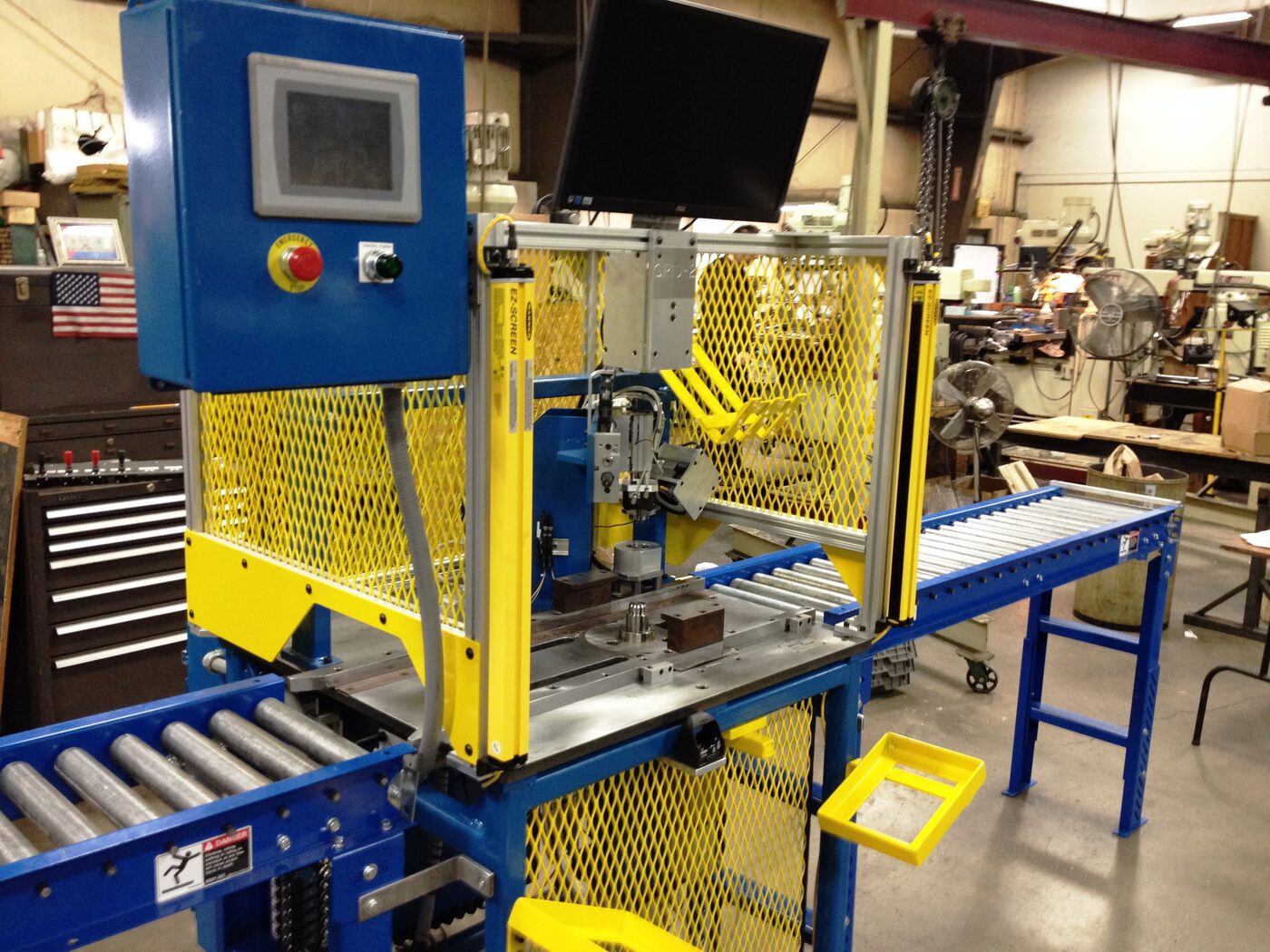
Behind those outcomes is a specific technical stack. Bristol platforms are built around PLC controls, AC/DC drives, servo motion, proportional hydraulic systems, and HMI interfaces with part-selection menus — meaning the operator interface is tuned for your SKU range, not a generic machine format. Envelope sizes are fully custom. If your part requires a footprint or an axis configuration that no catalog machine offers, the Bristol design starts from that requirement rather than forcing a compromise.
The Hidden Cost of the Near-Fit Machine
The most expensive automation purchase isn't the one that fails outright. It's the one that almost works. A near-fit machine reaches steady-state production — it runs, it produces parts, it passes initial qualification — but it runs at 78% of its rated throughput because your part geometry pushes one tooling interface just past the design envelope. Your controls team writes a workaround into the PLC program. The workaround becomes load-bearing. Two years later, when you need to update the line for a new part number, the workaround is in the critical path and the original integrator no longer supports the firmware version it runs on.
This is sustaining-engineering debt. It accumulates invisibly during the first year of operation and becomes visible when you try to change anything. Near-fit machines create it because they were built to a standard, not to your process. Every deviation from that standard is resolved through a patch — a mechanical shim, a software flag, a non-standard spare part stocked because the OEM's standard BOM doesn't cover your actual operating condition. Over a five-year horizon, those patches represent real engineering hours and real production risk.
There is also a throughput ceiling that near-fit solutions impose. Because the machine wasn't designed for your specific cycle, the process engineers who built it couldn't optimize the motion profile, the fixturing geometry, or the control logic for your part. You get rated throughput under ideal conditions, which means you get something less than that in production. A custom platform designed around your actual cycle time target — the 8.5 seconds, not the 45 — has no such ceiling because the ceiling was set by your process requirements, not a catalog spec.
When Off-the-Shelf Is the Right Answer
None of this argues that custom automation is always the correct path. Off-the-shelf equipment wins decisively in specific situations, and a credible engineering partner will tell you so before taking your project.
If your process is genuinely standard — common part geometries, operations that map cleanly to a catalog machine's designed duty cycle, volumes that fall well within the OEM's rated envelope — then a proven catalog platform validated across hundreds of identical installs carries lower process risk than a custom build. The integration path is documented. The spare parts are stocked. The service network exists.
Low-volume applications rarely justify the capital and lead time of a custom platform. If you're running a few hundred parts per week on a non-critical operation, the economics don't support a $300K custom build regardless of the cycle-time opportunity. Off-the-shelf fills that role correctly.
And when a catalog machine has been running successfully at five of your peers' facilities in a configuration that maps cleanly to your process, that installed base is evidence. It isn't worth discarding in favor of custom just because custom is available.
The honest question isn't "should we go custom?" It's "does our process fit the catalog — or are we about to spend the next two years engineering around the catalog's assumptions?"
The Decision Framework
Before committing capital either direction, a plant manager or VP of Manufacturing should be able to answer five questions. The answers don't make the decision automatically, but they surface the risk profile clearly enough to make the decision rationally.
1. How much does your process deviate from the catalog machine's designed use case? Pull the OEM's application guide and map your part dimensions, tolerances, cycle time requirements, and material properties against it. If you're within 10% of every parameter, the catalog machine probably fits. If you're outside that band on more than one axis, you've already started engineering a custom solution — the question is whether you're doing it deliberately or reactively.
2. What is the ten-year cost of the throughput gap? If the catalog machine delivers 85% of your target cycle time, calculate what that 15% gap costs in annual production capacity. Multiply by ten years. Compare that number to the delta between catalog cost and custom build cost. In most high-volume applications, the math resolves quickly.
3. Who owns the sustaining engineering? When a catalog machine needs a firmware update, a tooling change, or a process modification three years from now, who has the knowledge to execute it? If the answer is "the OEM's applications team, on a service contract," that dependency has a cost. If the answer is "the team that built it and still services it," that's a different risk profile entirely.
4. What is the service life expectation? A custom platform designed, built, and supported by a single engineering team — one that carries 100+ combined years of automation and tooling experience — can run for a decade or more without replacement. If your capital planning assumes a five-year refresh, you're leaving service life on the table. If it assumes ten, custom amortization looks very different.
5. Is the six-to-ten month lead time actually the constraint? Most capital equipment decisions have a ramp-up window built in. If you're planning a line expansion twelve months out, a custom build commissioned at month ten isn't slower than a catalog machine that required four months of post-installation rework to reach production throughput. The question isn't which machine ships faster. It's which machine produces qualified parts faster.
The Bristol Build: What the Investment Covers
Custom automation from Bristol Tool & Die – Automation runs from $150K to $750K and above, depending on the complexity of the platform, the number of integrated operations, and the control architecture required. That range covers single-station custom machines through multi-station integrated cells with full PLC logic, servo motion, proportional hydraulics, and HMI part-selection interfaces.
Every platform is built on a fabrication base that includes wire EDM machined to ±0.0001″, CNC milling, precision turning, and in-house abrasive waterjet capable of cutting up to 6″ steel at ±0.005″ accuracy on a 10′ × 20′ table. Mechanical and controls engineering are co-located under the same roof — the controls architecture is designed by the same team that designed the mechanical system, which means integration problems get resolved in the design phase rather than on the production floor during commissioning.
The arm-bar press platform built for a leading trailer-axle and suspension manufacturer has been described by that customer's engineering leadership as "the heart and soul of their suspension line." That's not marketing language — it's what happens when a platform is engineered so precisely to a production process that replacing it becomes operationally untenable. The machine doesn't just do the job. It becomes irreplaceable at it.
That outcome isn't accidental. It's the product of an engineering team with more than 100 combined years of experience in industrial automation and tooling, a fabrication floor capable of holding the tolerances required for long-service precision mechanisms, and a service model that keeps the original engineering team available when the platform needs attention years into its production life.
The six-to-ten month lead time is the cost of that outcome. For processes where the catalog alternative means accepting a throughput ceiling, accumulating sustaining-engineering debt, and planning a replacement within five years, it's among the most defensible investments in a manufacturing capital budget.
Frequently Asked Questions
Common questions about this topic.
How long does a custom Bristol automation platform typically take to build?
Most custom automation platforms take 6 to 10 months from contract through commissioning. That timeline covers process characterization, mechanical and controls design, fabrication, runoff, and site integration. The lead time reflects engineering work that cannot be compressed without compromising performance or service life.
What does custom automation from Bristol Tool & Die cost?
Custom automation projects range from $150K to $750K and above, depending on complexity, number of integrated operations, and controls architecture. Single-station custom machines sit at the lower end; multi-station integrated cells with full PLC, servo, proportional hydraulics, and HMI interfaces move toward the upper range.
When does off-the-shelf automation make more sense than a custom build?
Off-the-shelf automation is the right choice when your process maps cleanly to a catalog machine's designed use case, your volume falls within the OEM's rated duty cycle, and the machine has a validated installed base at comparable facilities. Low-volume, non-critical applications rarely justify the capital and lead time of a custom build.
The key test: does your process fit the catalog — or will you spend the next two years engineering around its assumptions?
What kind of service life can a custom Bristol platform deliver?
Multiple Bristol platforms have been in continuous production for 10 or more years. A 23-station shackle-link assembly cell has completed more than 4,000,000 part cycles. A hydraulic railing bender platform has been running at multiple marine OEM facilities for over a decade. A 14-station progressive die serving an industrial OEM has held the same record.
Service life of this length is only possible when the platform is engineered precisely to the process and supported by the original design team.
Ready to discuss your project?
Tell us your part, your volume, and your timeline. We’ll respond within one business day with a clear next step.